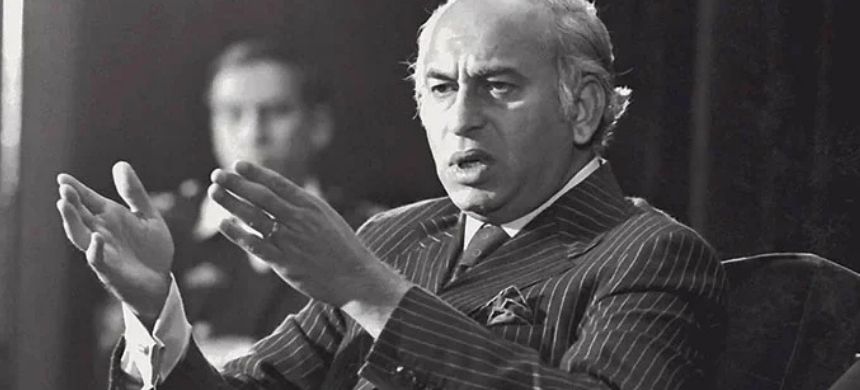
Bhutto, Islamic Socialism And The Pursuit For Power
“The legacy of Bhutto’s term continues to remain indelibly in Pakistan’s body politic. Undoubtedly, he was the most popular and effective leader that Pakistan has seen till date. However, it is equally true, that due to his arrogance and inability to tolerate dissent, he turned Pakistan from a fledgling democracy into a personal fiefdom where the rule of law was the greatest sufferer. In this process, he earned the hatred of a section of the population.”
-Iqbal Akhund, Trial and Error
The Minister:
Zulfikar Ali Bhutto’s political entry was incidental. After the death of his elder brother Imdad Ali Bhutto, Zulfikar succeeded his father, Shahnawaz Bhutto’s political legacy. Bhutto was eager to become a member of the Sindh Provincial Assembly in the elections of 1958, and his initial political advancement was through the association of his wife, Begum Nusrat Bhutto, with that of then President Iskander Mirza’s wife, both of whom happened to be of Iranian descent. He then won over the President’s affection through hospitality, accompanied by a generous dose of downright flattery and was inducted into the cabinet as the Minister of Commerce and Industries at the age of 31.
The Protégé:
After CMLA Muhmmad Ayub Khan took power, a strong bond developed between him and Zulfikar, so much so that Bhutto was to be asserted as Ayub’s fifth son.
In 1963, Ayub conferred on him, one of Pakistan’s highest civilian awards, the Hilal-E-Pakistan. For his part, Bhutto made the most of every opportunity in returning the President’s appreciation for him with stirringly pleasing public tributes in the National Assembly, which were to later cause Zulfikar great embarrassment, such as when he had termed Ayub Pakistan’s ‘Salahuddin’ in the Pakistan Annual.
The Rebel:
However, after the Tashkent Summit of 1966, relations between the President-Marshal and Foreign-Minister broke down. In 1966, Zulfikar was sacked, and left Rawalpindi by train, where then at Lahore Railway Station, people raised slogans and carried Bhutto on their shoulders, for during the Indo-Pak War of 1965 when Ayub had sent off Bhutto to plead Pakistan’s case in the United Nations, his performance won over the hearts of many of his countrymen, for he had vowed to fight a thousand years for Kashmir, exhilarating millions listening to their Foreign-Minister laying bare their emotions.
As his political momentum grew, so did the idea of establishing a new political party. It was then that he began corresponding with J.A Rahim, a former ambassador turned communist intellectual, who informed him of Leftist ideas. Zulfikar and Rahim then subsequently came together in 1967 to co-author a book titled the ‘Myth of Independence’, which came to provide the ideological underpinnings for what would become the Pakistan People’s Party.
With the finalization of its Interim Party Constitution and Foundational Documents, the People’s Party was officially founded in December of 1967. The Party expressed its philosophy as an aim to transform Pakistan into a socialist society with the achievement of central aims such as judicial independence, the abolishment of feudalism, intellectual freedom, education, emancipation, unionization and nationalization, which it presented in the form of its famous formulaic slogan:
‘Islam is our faith; Democracy is our Polity; Socialism is our Economy; All Power to the People’.
Shortly after the formation of the PPP, Zulfikar pledged to go so far as to sacrifice himself in the cause of Islamic Socialism. With theatrical performances at his rallies, he thrilled the crowd as he blended Islamic Socialism with their earthy language.
Bhutto’s timing was suitable, for Pakistani students were echoing dissent and swung behind the PPP. Ayub at last however ran out of patience and in 1968 placed him under house arrest, which backfired, as Zulfikar came to use his arrest as a stage from which he could express his stance, leading to street-agitation demanding his release.
By the beginning of 1969, all these developments came together to add to the anti-Ayub campaign. Ayub was left with little alternative as the strength of the movement grew against him and he was forced to hand over power to CIC Muhmmad Agha Yahya Khan, who assumed responsibility as Chief Martial Law Administrator.
The Premier:
The PPP’s election campaign came to last the entire year of 1970, Zulfikar had resolved that contesting East-Pakistan was futile, and he similarly paid little attention to Baluchistan. But in Punjab and Sindh, he had run a stirring campaign with promises of sweeping change and came to win an outstanding victory in West-Pakistan having made use of the desire for transformation among students, trade unionists and urbanites.
Bhutto did come to power but only after the loss of East-Pakistan. At the age of just 42, he satisfied his aspirations, but many continue to deliberate his responsibility in the break-up of Pakistan and much blame has been aimed at him, but even if he did contribute to the loss of East-Pakistan, he was in no sense solely answerable for what had transpired.
Zulfikar attempted to respond to his detractors in a short book, titled, The Great Tragedy, in which he attributed much of the blame to Ayub, Yahya and Mujib. With his assured writing style, Bhutto was largely a highly swaying essayist, but The Great Tragedy is his least compelling composition.
In December of 1971, he was sworn in as both President and Chief Martial Law Administrator of Pakistan and would also concurrently occupy 2 other offices, that of the President of the Constituent Assembly and Chairman of the PPP.
He inaugurated his first cabinet meeting by stating,
“Gentlemen, we are here for 20 years.”
He was however off by 14.
The Man:
Zulfikar Ali Bhutto was hanged on the 4th of April 1979, forever engraving his legacy into Pakistan’s body politic.
Bhutto was a contradiction. He was a feudal socialist, a populist aristocrat, an authoritarian democrat and an educated brute, all at the same time.
The gulf between Bhutto the man, Bhutto the politician and Bhutto the ruler led to alienation, transfiguring his supporters into adversaries, and his adversaries into enemies. He had an insecure, suspicious, cynical, authoritarian and megalomaniacal nature,
“I believe that he lacked a sense of dignity and value of other people, his own self was what counted. I sensed in him ruthlessness and a capacity for ill-doing which went far beyond what is natural.”
-British High Commissioner To Pakistan, Sir Morrice James, about Bhutto in the Pakistan Chronicles
On the other hand, Zulfikar was a man of the people. From 1967 to 1971, Bhutto went to the people as a leader; he went to where they lived, to their cities, towns and villages. There he connected with them and imparted to them that it was not predestined that they should remain desolate, that they had the right to respectability and that their hopes merited realization by political participation, beckoning them to the higher resolve of political consciousness.
The idea of Bhutto, and what he represented, surpassed the actuality of his flawed mortality. Today Bhutto has been immortalized in the national consciousness, to his apologists, as a Lenin, and to his critics as a Stalin.
Leadership reflects followership, and for better or for worse, Zulfikar Ali Bhutto, with his strengths and weaknesses, reflected the state of Pakistani society post-Ayub.
“In the days of his country’s tragedy, he held the remanent of his nation together and restored its self-confidence. In its hour of greatest need, he saved his country from complete destruction. But his courage and vision in 1971 should have earned him a better fate than the tragic end his passionate countrymen meted out to him and that blighted their reputation for mercy.”
-Henry Kissinger, The White House Years
(Pakistan Under Bhutto, by Shahid Javed Burki)
(Zulfi Bhutto Of Pakistan, by Stanley Wolpert)
(Pakistan A Dream Gone Sour, By Roedad Khan)