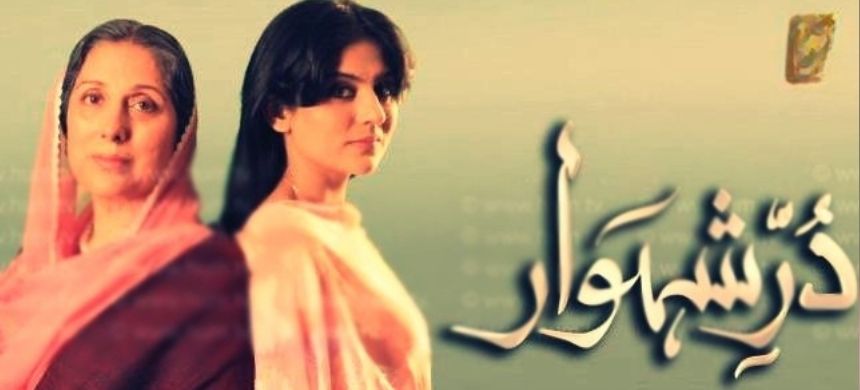
Despite having viewed this play umpteen times, it always manages to hit the bull’s eye. This time, when it was viewed, the writer felt that it was quite heavily biased, in favor of the protagonist, understandably so, since she was the one narrating it. The young Sanam Baloch (Durr-e-Shahwar), like any other young girl, has stars in her eyes, when she ties the knot with the handsome Mansoor (Mikaal Zulfiqar) and is unprepared for what lies ahead. What she things will be a bed of roses turns out to be quite the opposite, but it all boils down to a matter of perspective.
This production effectively captures how young girls are ill-prepared for marital life and the responsibilities which accompany it, especially when there is a huge difference in class and economic status. An individual is the product of their environment, so as rightly pointed out by Shahwar’s father, her mother-in-law has been raised in a completely different environment, where resources were limited and money was tight, hence the need to scrimp and save and count every penny.
On the other hand, Shahwar’s family has far more resources, as she hails from an affluent background. If the entire play is narrated from her mother-in-law’s point of view, it would be completely different, so as the writer earlier pointed out, it is all a matter of perspective and who is narrating the story.
Shahwar’s father plays a balancing act and very cleverly, guides and mentors her through the initial turbulent period of her marital life. As Shahwar tells her sister-in-law, mohabbat aur khayal dinon main nahin aata ya hota, it takes years, when she complains about her husband’s indifference and lack of concern. On viewing it again, the mother-in-law, although initially, appears to be a very rigid and unsympathetic character, but then, from what little information is given, it can be easily gleaned that she has had a very difficult life and if a prequel were ever made about her, the viewers would be able to sympathise with her and understand where she is coming from.
She did not have the kind of resources that Shahwar’s mother did, so as her father explains it very logically to her, cannot be compared to her mother-in-law. The question arises as to why Shahwar, who was an educated, attractive and intelligent woman, from a wealthy family, was married off to Mansoor, whose family and household dynamics were completely different. There was a huge difference in status and class, which manifested itself on a number of occasions, for example, when Shahwar is instructed not to wear very expensive clothes around the house, in case her sisters-in-law develop an inferiority complex and start asking for the same.
The dynamics of a lower middle class household have been expertly captured and some of the harsh realities that the new entrant is exposed to, might seem very unfair, but when viewed from the point of view of the mother-in-law, seem perfectly logical.
Like an onion, this play has many layers and can be seen from a fresh perspective, each time it is viewed. It all boils down to how you view a situation and the kind of background you hail from. If you have been brought up in a culture of poverty, your outlook and viewpoint in life will be completely different, as is the case with Shahwar’s mother-in-law, whose only fault is that instead of breaking this vicious cycle, she ends up perpetuating it.
After all, if Shahwar had a brother, her sister-in-law would also be expected to adjust and make compromises, so as not to rock the marital boat. Relationships are a complicated affair and although, most of the compromises have to be made by the women when they marry, men face their share of adjustment problems also, so if this play were narrated from Mansoor’s point of view, it would be completely different.
No one is right or wrong here; people are a product of their environment and circumstances. This play, as mentioned, is primarily Durr-e-Shahwar’s story, narrated from her perspective, so she is portrayed in a sympathetic light. But in retrospect, every individual in that household has their own challenges and problems; Mansoor is the sole bread winner and therefore, shoulders a heavy responsibility and is also under pressure to fulfill the expectations of his parents, as the elder son. With two sisters that have to be married off and a younger brother who is studying, managing the house within his salary and his father’s pension, is a huge challenge for his mother.
Shahwar has never had to face any financial issues in her parents’ home, so cannot be blamed for not understanding his predicament. This play effectively highlights the fact that change is gradual and takes time, so although things might appear to be very difficult initially for newly married girls, eventually, the tide does turn in their favour and things start looking up. The role of the parents is also very important, as they have to guide and mentor their daughters, to make the transition period easier for them. The only constant in life is change and if you have faith and someone like Shahwar’s father to help you navigate your way through all the initial ups and downs, the tide will and does turn in your favour!
An ever green play which educates, entertains and informs in equal measure, and never fails to disappoint, irrespective of how many times it is viewed!