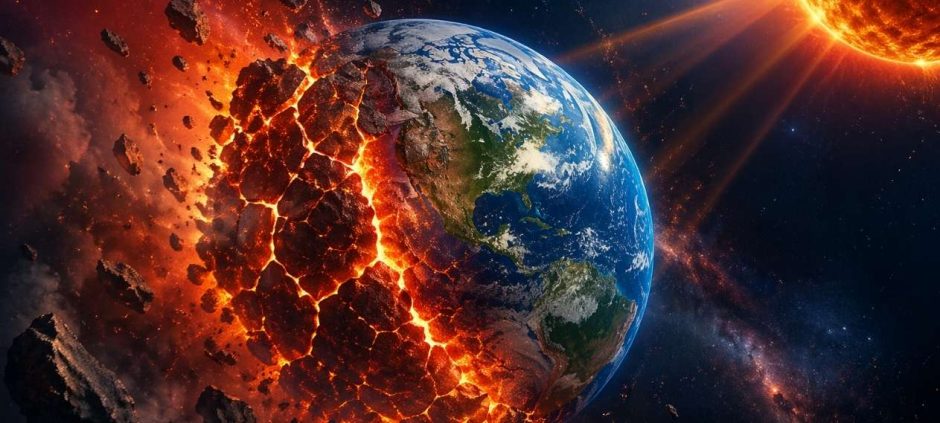
Scientists have long debated how life on Earth might eventually come to an end. Many people assume a sudden event, such as an asteroid impact or the Sun engulfing the planet, would be the main cause. However, recent studies suggest a slower and more gradual process.
According to scientific research, the biggest threat to life on Earth may come from changes in its atmosphere. Over billions of years, the Sun naturally becomes hotter as it ages. This gradual increase in temperature can lead to significant environmental changes.
Experts explain that rising temperatures on Earth will cause more water to evaporate from oceans and land surfaces. Water vapor is a powerful greenhouse gas. As more vapor enters the atmosphere, it traps heat and accelerates warming. This process is known as a runaway greenhouse effect.
A scientific review by NASA suggests that Earth could become uninhabitable for complex life forms in just over one billion years. This timeline is much earlier than the stage when the Sun expands into a red giant, which is expected to happen in about five billion years.
Further research published in Nature Geoscience supports this idea. Studies led by Kazumi Ozaki and Christopher Reinhard used climate models to simulate the future of Earth’s atmosphere. After thousands of simulations, they found that oxygen levels could decline significantly over time.
This reduction in oxygen could make the atmosphere unsuitable for complex life. The research suggests that oxygen levels may remain stable for around 1.1 billion years before dropping sharply. This means life on Earth could face serious challenges even before oceans fully disappear.
Another study by Keming Zhang indicates that Earth may remain habitable for about one billion more years. After that, oceans could gradually vanish, further reducing the chances of life.
Scientists emphasize that these changes will occur over extremely long time scales. They are not linked to current climate change, which is driven by human activity and other factors.
In other news read more about: Why Earth Day Is Celebrated on April 22: History and Significance
Overall, the findings show that the future of Earth is shaped by natural processes that unfold slowly. While these events are far beyond human lifetimes, they offer valuable insight into the long-term evolution of the planet.