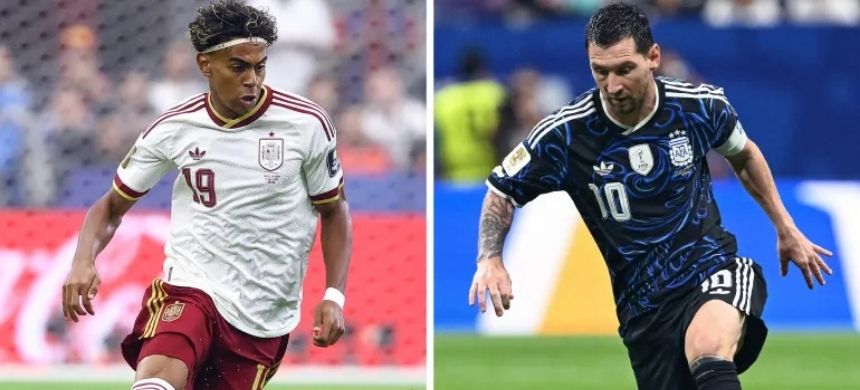
The FIFA World Cup 2026 final brings together two teams with contrasting strengths. Defending champions Argentina enter the showdown with the tournament’s most productive attack, while Spain arrive with its strongest defensive record. The final will be played at New York New Jersey Stadium on Sunday, with Lionel Messi and Lamine Yamal providing the contest’s biggest individual storyline.
This is more than a battle for the trophy. It represents experience against youth, attacking power against defensive control, and Argentina’s fighting spirit against Spain’s carefully organised possession football.
Messi is looking to strengthen an already extraordinary legacy. Yamal, meanwhile, has an opportunity to establish himself as the defining star of a new generation.
Argentina vs Spain: Key Comparison
| Category | Argentina | Spain |
|---|---|---|
| Main strength | Goals, creativity and late pressure | Possession, pressing and defensive structure |
| Key player | Lionel Messi | Lamine Yamal |
| Midfield leaders | Enzo Fernández, De Paul, Mac Allister | Rodri, Fabián Ruiz, Dani Olmo |
| Preferred approach | Fast transitions and direct attacks | Patient possession and territorial control |
| Biggest advantage | Tournament experience | Tactical discipline |
| Main concern | Breaking Spain’s compact defence | Containing Messi in dangerous areas |
Official tournament figures present the final as a meeting between the competition’s best attack and best defence. Argentina have scored more goals than any other team, while Spain have allowed fewer than anyone else.
Spain Could Neutralise Argentina’s Attack
Argentina’s attacking record is impressive, but Spain have repeatedly prevented strong opponents from playing at their preferred tempo.
Spain press aggressively when possession is lost. Their midfielders close passing lanes quickly, while the defenders maintain a disciplined shape behind them. This organisation forces opponents into rushed decisions and limits opportunities near the penalty area.
Spain demonstrated that control in the semifinal, defeating France 2-0 after dominating long periods of the match. They restricted a dangerous French attack through possession, positioning and coordinated pressure.
Should Spain dominate the ball again, Argentina could spend significant periods defending rather than creating chances.
Rodri’s Role in Limiting Messi
Trying to remove Lionel Messi from a match completely is almost impossible. Spain’s more realistic objective will be to control where he receives possession.
Rodri, supported by Fabián Ruiz and Dani Olmo, is likely to protect the area between midfield and defence. The trio will attempt to prevent Messi from receiving the ball close to Spain’s penalty area.
Messi remains dangerous from deeper positions because of his passing range. However, Spain would rather see him collecting possession 40 yards from goal than turning toward the defence inside the final third.
The tactical contest involving Rodri and Argentina’s midfield could therefore be more decisive than any individual duel.
Lamine Yamal Could Target Argentina’s Left Side
The final may also become Lamine Yamal’s defining international moment.
His speed, close control and willingness to attack defenders could place Argentina’s left side under constant pressure. Nicolás Tagliafico may require regular support from a midfielder or winger, potentially creating space elsewhere for Spain.
Allowing Yamal repeated one-on-one opportunities would be dangerous. Argentina may respond by defending deeper, but that could give Spain even greater territorial control.
FIFA has identified Yamal’s matchup with Argentina’s left side as one of the individual battles capable of deciding the final.
Argentina Will Not Surrender Easily
Spain may appear tactically stronger, but Argentina possess qualities that statistics cannot fully measure.
The defending champions are experienced in tense knockout matches and remain dangerous when games become stretched. Even during difficult periods, Messi can change the contest with one pass, free kick or unexpected movement.
Julián Álvarez offers energy behind the defence, while Rodrigo De Paul brings aggression and urgency in midfield. Argentina can also increase the pressure late in matches by committing additional players forward.
A Spanish lead would not necessarily settle the final. Argentina are likely to continue attacking until the final whistle.
Messi Can Control the Match Without Scoring
Messi’s influence should not be judged only through goals and assists.
His positioning attracts defenders and creates openings for teammates. Spain’s players will constantly monitor his movement, even when he is away from the ball. That attention can create space for Álvarez, Mac Allister and Argentina’s wide attackers.
Spain’s challenge is therefore not simply to reduce Messi’s touches. They must prevent his presence from disrupting their defensive organisation.
Messi has scored eight goals in the tournament heading into the final, underlining the threat he continues to provide.
The Midfield Battle Could Decide Everything
The final may ultimately be settled in midfield.
Rodri will attempt to control possession and dictate Spain’s tempo. Fabián Ruiz and Dani Olmo will look to move into spaces around Argentina’s midfield line.
Argentina will rely on De Paul, Enzo Fernández and Alexis Mac Allister to interrupt that rhythm. Their ability to win possession and launch fast transitions could expose Spain before their defensive shape is restored.
Should Spain control the centre, they will probably control the match. Should Argentina turn the game into a quick, physical and unpredictable contest, Messi’s team will have a far greater chance.
Why Spain Enter as Slight Favourites
Argentina have the tournament’s strongest attack, championship experience and one of football’s greatest players.
Spain counter those strengths with superior defensive numbers, patient possession and a highly coordinated pressing system. They have already eliminated Portugal, Belgium and France during the knockout rounds, conceding only once across those three matches.
Spain’s structure may provide the decisive advantage, particularly if they score first and force Argentina to abandon their preferred balance.
Final Prediction
Spain 2–1 Argentina
Argentina should create dangerous moments, and Messi is likely to influence the final even without scoring. However, Spain’s defensive consistency, midfield control and ability to manage the tempo could help them survive a dramatic finish.
A Spanish victory would deliver the country’s second World Cup title. It would also create a symbolic moment: Messi, the established Barcelona legend, sharing football’s biggest stage with Yamal, the young star widely viewed as part of the sport’s future.
The prediction favours Spain—but Argentina’s experience ensures the trophy will not be won easily.
Read more: Louis Vuitton Unveils Trophy Trunk for FIFA World Cup Final