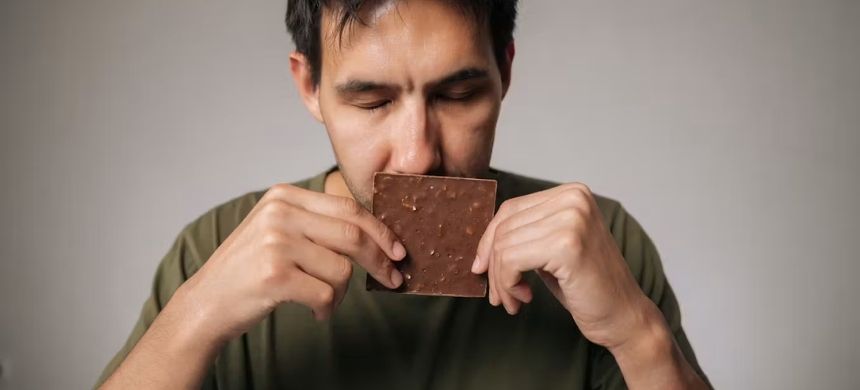
A new study published in Frontiers in Physiology suggests that simply smelling chocolate before and during resistance training may slightly improve exercise performance. While the findings are promising, researchers caution that the study was small and should not yet be considered a basis for general fitness recommendations.
The research involved 23 healthy men in their early to mid-20s who had previous experience with resistance training. Before taking part in the experiment, participants fasted for at least 10 hours. They were then divided into three groups. One group smelled liquefied 90% dark chocolate, another inhaled the scent of 60% milk chocolate, while the control group was exposed to odorless water.
The participants performed leg extension exercises, a common strength-training movement that targets the quadriceps. Throughout the workout, researchers monitored appetite, hunger levels, feelings of fullness, and exercise performance.
The results showed that both chocolate scents helped participants complete more repetitions than those in the control group. According to senior researcher Dr. Mohamed Nashrudin bin Naharudin, those exposed to dark chocolate completed around 18 additional repetitions, while the milk chocolate group performed approximately nine extra repetitions. Despite doing more work, participants did not report feeling that the exercise was any more difficult.
Researchers also found that the dark chocolate aroma had a stronger effect on appetite. Participants who smelled dark chocolate reported feeling less hungry and more satisfied before exercising. Milk chocolate, while considered more pleasant to smell, did not significantly affect hunger levels.
The team believes that familiar food aromas may influence both appetite and physical performance through learned psychological associations. However, they did not measure hormone levels, digestive responses, or brain activity, meaning the exact reason behind the results remains uncertain.
The researchers stressed that the study had several limitations, including its small sample size and focus on young men only. More comprehensive research involving different age groups and larger populations will be needed to confirm whether smelling chocolate—or other appealing food aromas—can consistently improve workout performance.
For now, the findings offer an intriguing glimpse into how something as simple as a familiar scent could potentially influence exercise without making it feel more demanding.
Also Read: KitKat Chocolate Heist: 12 Tons Missing, Investigation Begins