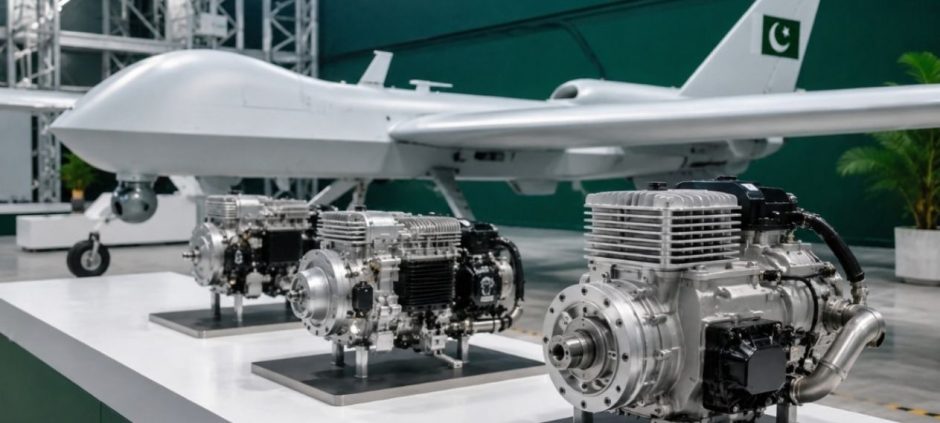
Pakistan has introduced its first locally manufactured UAV Engine for Drones, marking an important step toward expanding the country’s domestic defence industry. The new propulsion systems were unveiled at the Eurosatory 2026 defence exhibition in Paris by Karachi-based Alsons Group through its aerospace division, Advanced Kinetic Aerospace Labs (AKAL).
The launch represents a significant move toward reducing Pakistan’s reliance on imported drone engines. It could also help lower production costs for locally developed unmanned aerial vehicles and loitering munitions.
Alsons is widely known for producing automotive parts and electronics. Its entry into aerospace manufacturing highlights the growing role of private companies in Pakistan’s defence sector.
Pakistan’s Ministry of Defence Production has recently increased cooperation with private drone developers. The government has identified indigenous drone technology as a national priority. Discussions with industry have focused on testing facilities, procurement policies, research support, and regulations.
Several Pakistani companies are already developing surveillance drones, target drones, armed multirotor aircraft, cruise missile-type systems, and long-range loitering munitions. The addition of a locally built UAV Engine for Drones could strengthen the country’s defence supply chain.
Local Engine Production Could Reduce Costs
According to Alsons, AKAL designed, engineered, and manufactured the new propulsion systems entirely in Pakistan.
The company displayed four small piston engines designed for affordable unmanned aircraft. These engines are intended for target drones, surveillance platforms, and one-way attack systems. They may also be used in loitering munitions that remain airborne before striking a target.
Pakistan has already developed several drone platforms. However, many still depend on imported engines and critical components. A domestic UAV Engine for Drones could reduce this dependence while allowing larger-scale production.
Small UAV engines often use proven or licensed designs instead of completely new concepts. This approach helps reduce development costs and speeds up production, especially for lower-cost unmanned systems.
Alsons has not yet revealed technical specifications, power output, operating range, or the drone platforms that will use the engines.
Private Sector Expands Defence Manufacturing
The project reflects the increasing participation of private companies in Pakistan’s defence industry.
Recent global conflicts have highlighted the growing importance of affordable drones and mass-produced strike systems. Countries are investing in low-cost technologies that can be produced quickly and in large numbers.
Manufacturing engines locally could reduce foreign exchange spending and limit dependence on overseas suppliers. It may also help Pakistan avoid supply chain disruptions and export restrictions.
Pakistan increased its defence budget by 17.65 percent for the 2026-27 fiscal year. However, the weaker rupee has reduced the value of imported military equipment. Local production of engines, sensors, electronics, and other components could improve long-term cost efficiency.
Export Opportunities May Drive Future Growth
Pakistan already manufactures the Fatah series of guided weapons and the Babur family of cruise missiles. However, propulsion has remained one of the country’s biggest challenges for smaller unmanned platforms.
The newly introduced UAV Engine for Drones could help close that gap. It may support future production of target drones, surveillance aircraft, and low-cost strike systems.
Still, engines alone do not create a complete drone system. Manufacturers also need reliable airframes, navigation equipment, communications systems, guidance technology, warheads, and production infrastructure.
Alsons used Eurosatory 2026 to introduce AKAL to international customers and explore export opportunities. Future partnerships or overseas orders could support larger production facilities and lower manufacturing costs.
In other related news also read Pakistan Army Opens Captain Recruitment for Engineers
The company has not announced commercial customers or revealed performance data for the engines. Industry observers will now watch whether the new propulsion systems move into large-scale production and become part of Pakistan’s next generation of unmanned aircraft.