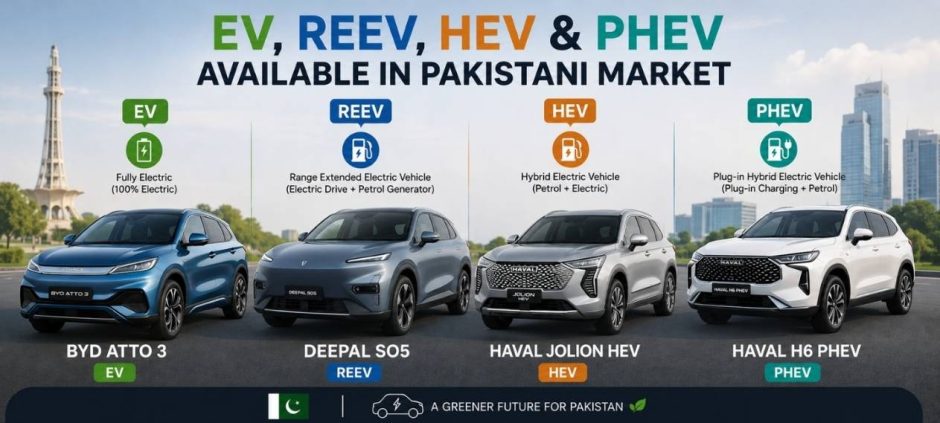
Electric cars are becoming popular in Pakistan. Fuel prices keep rising every year. Many people now want a cleaner and cheaper way to drive. But there is one big problem. Most buyers don’t know the different electric vehicle types. This confusion makes buying decisions hard.
In this blog, we will explain all electric vehicle types in easy words. We will also share their pros and cons. By the end, you will know which one suits Pakistan best.
What Are Electric Vehicles?
An electric vehicle uses electricity to move. It does not always need petrol or diesel. Some electric vehicles use only a battery. Others mix a battery with a small engine. This mix creates different electric vehicle types.
Each type works in its own way. Each has its own price, range, and maintenance needs. Let’s look at them one by one.
Main Electric Vehicle Types Explained
1. Electric Vehicles (EVs)
A Battery Electric Vehicle runs only on electricity. It has no petrol engine at all. You charge it using a plug, just like a mobile phone.
EVs Available in Pakistan
- MG ZS EV, sold officially through local dealers.
- Nissan Leaf, a common JDM import in Pakistan.
- Sazgar Prince Pearl EV, a small city car.
- BYD Atto 3 and BYD Han, brought in as imports.
- Haval imported EV models, seen in limited numbers.
Advantages of EVs
- Zero tailpipe emissions. This means no smoke or pollution.
- Very low running cost. Electricity is cheaper than petrol.
- Quiet and smooth driving experience.
- Fewer moving parts. This means less mechanical repair.
Disadvantages of EVs
- Charging stations are still rare in Pakistan.
- Charging takes longer than filling petrol.
- Battery replacement can be expensive.
- Long trips need careful route planning.
2. Hybrid Electric Vehicles (HEVs)
A Hybrid Electric Vehicle has both a petrol engine and a small battery. You never plug it in. The engine and braking system charge the battery automatically.
HEVs Available in Pakistan
- Toyota Aqua, a popular small hybrid import.
- Honda Vezel Hybrid, widely used across the country.
- Honda Fit Hybrid, common in the used car market.
- Toyota Prius, one of the earliest hybrids in Pakistan.
- Toyota Corolla Cross Hybrid, sold through official dealers.
Advantages of HEVs
- No need to charge at a plug point.
- Better fuel mileage than normal petrol cars.
- Easy to use, just like a regular car.
- Widely available in Pakistan’s used car market.
Disadvantages of HEVs
- Cannot run on pure electric power for long.
- Still uses petrol, so it is not fully clean.
- Battery repair can be costly after some years.
- Less fuel saving compared to plug-in options.
3. Plug-in Hybrid Electric Vehicles (PHEVs)
A Plug-in Hybrid is a step between HEVs and full EVs. It has a bigger battery than a normal hybrid. You can charge it using a plug. It also has a petrol engine as backup.
PHEVs Available in Pakistan
- Mitsubishi Outlander PHEV, imported in small numbers.
- Toyota Prius Prime, seen occasionally in the used market.
- BYD Qin Plus DM-i, brought in by private importers.
- Haval H6 PHEV, available through select dealers.
Advantages of PHEVs
- Can drive short trips on pure electric power.
- Petrol engine removes range anxiety on long roads.
- Better fuel efficiency than regular hybrids.
- Good option if home charging is possible.
Disadvantages of PHEVs
- More expensive than normal hybrids.
- Heavier due to bigger battery and engine.
- Needs regular charging for best fuel savings.
- Maintenance can be complex, with two power systems.
4. Range Extended Electric Vehicles (REEVs)
A Range Extended Electric Vehicle is mainly electric. But it carries a small petrol engine too. This engine does not power the wheels directly. It only charges the battery when power runs low.
REEVs Available in Pakistan
- Nissan Note e-Power, a popular JDM import with this system.
- Nissan Serena e-Power, common in the used van market.
- Deepal SO5, brought in by private importers.
- BMW i3 REx, rare and found only occasionally.
Advantages of REEVs
- Drives like a full electric car most of the time.
- Removes the fear of running out of charge.
- Lower emissions than regular hybrid cars.
- Good for areas with weak charging networks.
Disadvantages of REEVs
- Rare and hard to find in Pakistan.
- Spare parts may be difficult to source.
- Still burns some fuel during long trips.
- Usually more expensive than hybrids.
Comparing All Electric Vehicle Types
Here is a quick comparison to make things clear.
EVs need charging and use no fuel at all. They work best for city driving and short commutes. HEVs need no plug and run on petrol plus battery power. They suit daily use without any charging hassle. PHEVs use both a plug and petrol. They work well for mixed city and highway driving. REEVs also use a plug, with a small backup engine. They suit long drives while still feeling like an EV.
This comparison shows how electric vehicle types differ in daily use.
Which Electric Vehicle Type Is Best for Pakistan?
Pakistan still lacks enough charging stations. Petrol remains widely available across the country. Because of this, full battery electric vehicles are still hard to use daily.
Hybrid Electric Vehicles are the most practical choice right now. They need no charging setup. They also save good fuel compared to petrol-only cars. Many Japanese hybrids like the Honda Vezel and Toyota Aqua already run well in Pakistan.
Plug-in Hybrids are a smart choice for homeowners. If you can charge at home, a PHEV gives you the best of both worlds. It saves fuel and still has petrol backup for long trips.
Pure EVs are ideal for future use. As charging stations increase, EVs will become more practical. For now, they suit people who mostly drive within cities.
REEVs remain a small niche. They are hard to find and costly to maintain in Pakistan.
For most Pakistani buyers today, hybrids offer the best balance. They combine low running cost with easy daily use.
Frequently Asked Questions (FAQs)
Q1: What is the main difference between EV and hybrid cars? An EV runs only on electricity. A hybrid car uses both petrol and electricity together.
Q2: Are electric vehicles available in Pakistan? Yes, but choices are limited. Charging infrastructure is still developing across the country.
Q3: Which electric vehicle type saves the most fuel? Plug-in hybrids usually save the most fuel. This is true if you charge them regularly.
Q4: Is a hybrid car a good choice for Pakistan? Yes. Hybrids need no charging and still save good fuel money.
Q5: Can I use an EV for long trips in Pakistan? It is difficult right now. Charging stations are limited outside major cities.
Q6: What does REEV mean? REEV means Range Extended Electric Vehicle. It uses a small engine only to charge the battery.
Q7: Which electric vehicle type is cheapest to maintain? Battery Electric Vehicles usually cost less to maintain. They have fewer moving parts than other types.
Final Thoughts
Understanding different electric vehicle types helps you choose wisely. Each type, from EVs to REEVs, has its own strengths and weaknesses. For Pakistan today, hybrids remain the most practical and affordable choice. As charging networks grow, full electric vehicles will become a stronger option for everyone.
Choosing the right electric vehicle types depends on your budget, driving habits, and access to charging. Think about your daily routine before making a final decision.