The Pakistan Medical & Dental Council (PM&DC) has decided to introduce mandatory fire safety education and training for house officers working in medical and dental colleges across Pakistan.
The initiative is aimed at improving fire safety awareness, emergency preparedness and response capabilities in healthcare institutions. The council says the training will help protect doctors, patients, students and other hospital staff during fire-related emergencies.
Fire safety training to become part of house job
According to PM&DC President Prof. Dr. Rizwan Taj, fire safety training will be incorporated into the house job program for medical and dental graduates.
Dedicated training hours will be allocated for house officers to learn essential fire safety procedures. The program will focus on fire prevention, emergency drills, patient safety and appropriate evacuation procedures.
The decision follows a review of existing fire safety protocols and the identification of areas requiring improvement. PM&DC has emphasized the need to strengthen safety education within medical colleges and teaching hospitals operating under its regulatory framework.
House officers to receive practical emergency training
The proposed program will go beyond basic awareness and include practical exercises designed to prepare house officers for real emergency situations.
Regular fire safety drills and evacuation exercises will be conducted at medical colleges and teaching hospitals. These activities are intended to establish a stronger culture of preparedness and ensure that healthcare workers can respond quickly when an emergency occurs.
House officers will also be trained to identify potential fire hazards within healthcare facilities and understand the appropriate steps to take when a fire breaks out.
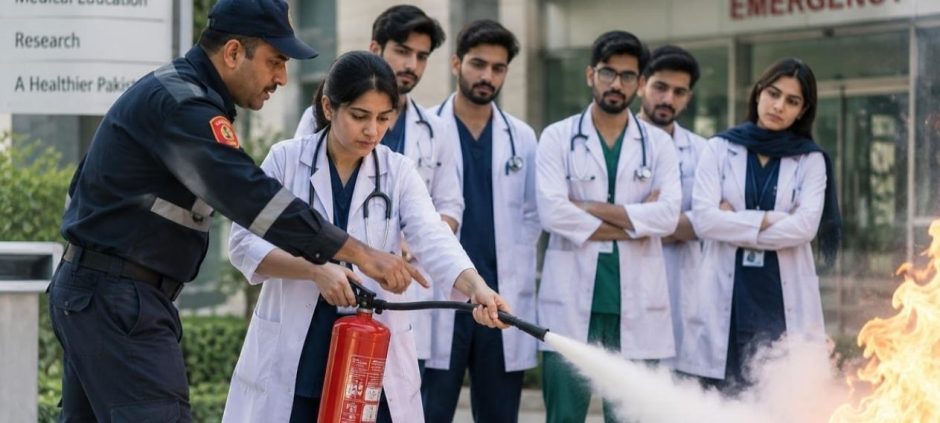
The training will include guidance on the use of fire extinguishers, following designated evacuation routes and communicating emergency situations effectively.
Focus on patient safety
PM&DC has highlighted the particular importance of fire preparedness in hospitals because healthcare facilities accommodate patients who may not be able to evacuate independently.
Patients who are critically ill, elderly, injured or undergoing treatment may require assistance during an emergency. Healthcare workers therefore need to understand evacuation procedures and be prepared to act quickly while maintaining patient safety.
Prof. Dr. Rizwan Taj stressed the importance of strengthening fire prevention and emergency response measures at medical institutions.
The council wants medical colleges and teaching hospitals to maintain effective fire safety arrangements and emergency preparedness systems to safeguard students, house officers, patients, doctors and other staff.
Medical colleges and hospitals urged to strengthen arrangements
Under the planned approach, medical colleges and teaching hospitals will be expected to ensure that adequate fire safety arrangements are in place.
The initiative is intended to address weaknesses in existing preparedness measures and encourage institutions to take preventive action rather than depending entirely on emergency response teams after an incident occurs.
PM&DC has indicated that new protocols will focus more strongly on emergency preparedness, training and prevention.
The council believes that regular drills can help healthcare workers become familiar with evacuation routes, emergency communication procedures and other safety measures before an actual incident takes place.
Training could eventually cover all healthcare professionals
PM&DC President Prof. Dr. Rizwan Taj has also expressed interest in expanding the fire safety education program beyond house officers.
The council is considering extending similar training to medical students, postgraduate trainees and eventually other healthcare professionals.
The move reflects the view that fire safety and emergency preparedness are important skills for healthcare workers because hospitals and medical institutions can face complex emergency situations involving large numbers of people.
By introducing structured training at an early stage of medical careers, PM&DC aims to improve awareness and preparedness among future healthcare professionals.
A stronger culture of preparedness
The mandatory training program represents an effort to make fire safety an integrated part of medical education and professional training.
Rather than relying solely on emergency response teams, PM&DC wants doctors and healthcare workers to understand their responsibilities during a fire emergency and be capable of responding appropriately.
Regular drills, hazard identification, extinguisher training, evacuation exercises and emergency communication could help reduce confusion during an incident and support faster decision-making.
The council’s initiative is expected to place greater emphasis on preventive safety measures across medical colleges and teaching hospitals, while encouraging institutions to establish safer learning and working environments for everyone.
Also read: PMDC Announces MDCAT 2026 Schedule