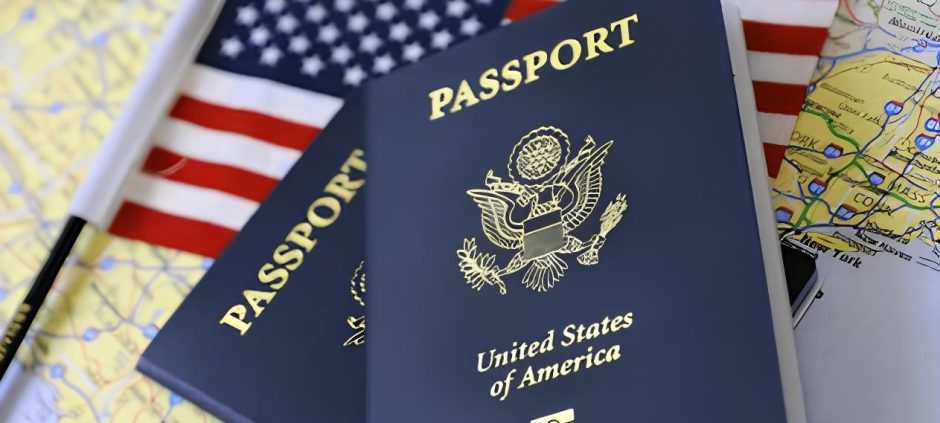
The US State Department has proposed new passport requirements that could require parents or legal guardians to provide proof of their own citizenship or immigration status when applying for passports for children.
The proposed changes are part of President Donald Trump’s latest effort to restrict birthright citizenship and address what his administration describes as “birth tourism,” according to draft guidance reviewed by Reuters.
New Documentation Requirements Proposed
Under the proposed rules, parents applying for a US passport for a child born in the United States could be required to submit documentation showing their citizenship or immigration status.
US citizens could be asked to provide documents such as a valid US passport or birth certificate. Parents who are not US citizens could be required to provide evidence of their immigration status, including an I-94 form or lawful permanent resident card.
The State Department says the information would be used to determine whether a child is affected by the provisions of Trump’s latest executive order.
“The Department will require parental information and evidence of parental citizenship or immigration status,” the draft guidance states, referring to Executive Order 14418.
Current Passport Process Could Change
Under the current process, parents of children born in the United States generally provide evidence of their relationship to the child and valid photo identification when applying for a passport.
Parents are also asked to indicate on the application whether they are US citizens, but they are not currently required to submit supporting documentation proving their citizenship as part of that declaration.
The proposed guidance would therefore represent a significant change in the information parents may have to provide during children’s passport applications.
Trump’s Effort to Limit Birthright Citizenship
The proposal follows Trump’s August 6 executive order targeting birthright citizenship, particularly cases involving foreign nationals who travel to the United States to give birth.
The order seeks to expand the circumstances in which citizenship could be denied to children born in the United States.
Under the directive, children could be excluded from citizenship in certain circumstances involving parents who work for foreign governments, engage in fraud or commercial transactions intended to obtain citizenship, or are classified as “alien enemies.”
The administration has made limiting birthright citizenship a major part of its broader immigration agenda.
Supreme Court Has Already Challenged Earlier Order
Trump’s latest initiative follows an earlier executive order that sought to significantly narrow automatic citizenship for children born in the United States.
That earlier order would have limited birthright citizenship to children with at least one parent who was a US citizen or lawful permanent resident.
However, the US Supreme Court ruled against that approach in a 6-3 decision, with the majority finding that the order violated the Citizenship Clause of the 14th Amendment to the US Constitution.
The August 6 order is narrower than the earlier measure, but it could still face legal challenges.
Legal Challenges Underway
Lawyers representing babies who could potentially lose citizenship under Trump’s earlier order have filed class-action lawsuits seeking to prevent the latest directive from taking effect.
One of the cases is being considered by US District Judge Deborah Boardman in Maryland.
During a recent hearing in Greenbelt, Boardman expressed skepticism about the administration’s order and allowed plaintiffs to revise their lawsuit so the court could consider whether to block the directive.
Justice Department lawyers have argued that an immediate restraining order would not be appropriate because federal agencies had not yet publicly issued detailed guidance explaining how the order would be implemented.
State Department Defends Proposal
The State Department has defended the proposed passport changes as part of the administration’s broader effort to ensure that its passport process reflects the president’s citizenship policies.
State Department spokesman Tommy Pigott said the administration intends to protect the “meaning and value” of American citizenship and ensure that passport adjudication procedures reflect those standards.
The proposal has yet to become a final rule, and its implementation could depend on ongoing legal proceedings and further guidance from federal agencies.
If adopted, the changes could require parents to provide considerably more documentation when seeking passports for their US-born children.
The development is likely to remain closely watched as courts consider the legality of Trump’s birthright citizenship policies and the administration works to establish how the latest executive order would be enforced.
Also read: US Universities Send Urgent Alert to International Students