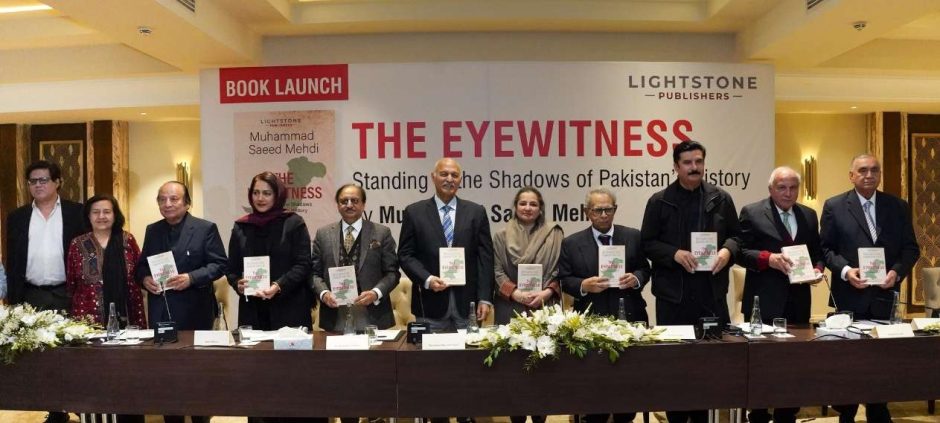
Islamabad, 24 January 2026: Lightstone Publishers launched The Eyewitness: Standing in the Shadow of Pakistan’s History by Muhammad Saeed Mehdi, former principal secretary to Prime Minister Nawaz Sharif, former chief secretary Sindh, and senior civil servant, in Islamabad. The book presents a firsthand account of Pakistan’s political history, documenting defining national moments closely witnessed by the author.
Ameena Saiyid, Managing Director of Lightstone Publishers, welcomed everyone with the opening remarks.“This has been one of the most successful books to be published by Lightstone due to the unique life history experiences of the author. The response and interest of the audience have been overwhelming. It is heartening to see so much interest in books these days.” — Omayr Aziz Saiyid, Director Lightstone Publishers
Senior journalist and political analyst Asma Sherazi, speaking at the launch, described the autobiography as a vital factual record of Pakistan’s political timeline. She said she read the manuscript in one sitting and referred to Mr. Syed Mehdi as a “chosen witness,” present at nearly every critical juncture from the fall of Dhaka to Kargil capturing an emotional journey marked by helplessness, power, and vulnerability.
The event was attended by over 500 guests, including politicians, journalists, and literary figures. Notable attendees included Syeda Abida Hussain, Fakhar Imam, Raheela Durani (Education Minister, Balochistan), Sikandar Sultan Raja (ECP), Ambassador Sarwar Naqvi, Rubab Sikander, Shaheen Masood, and many others. Prominent journalists such as Aizaz Syed and Farhat Ullah Babar, as well as literary personalities, were also present. The launch featured a performance of Shama Saiyid singing Sohni Dharti.
Addressing the audience, Muhammad Saeed Mehdi said the book records what he called “living history,” shaped by decades of service at the highest levels of government. Reflecting on the essence of his memoir, he remarked, “The gist of my book is this: the thing everyone is afraid to say you write that thing.”
“My journey as a civil servant has often put me in the position of a bystander to great and even terrible events. I have tried my best to be as correct and precise in narrating facts as I saw them.” — Muhammad Saeed Mehdi
Mehdi noted that the memoir is descriptive rather than investigative, reflecting personal experiences, successes, and failures, while leaving interpretation to historians. His career placed him at several pivotal moments in Pakistan’s history. As deputy commissioner of Rawalpindi, he witnessed the final phase of former Prime Minister Zulfikar Ali Bhutto’s trial and was the last official to meet him before his execution. As commissioner of Lahore, he received Benazir Bhutto upon her return from exile in 1986. Later, as principal secretary to Prime Minister Nawaz Sharif, he witnessed the events leading to the 1999 military takeover and subsequently spent two years in imprisonment.
Senator Mushahid Hussain Sayed described the memoir as an important addition to Pakistan’s historical record, bridging the gap between behind-the-scenes decision-making and public understanding.
Senior journalist and editor Malik Zahoor Ahmed termed it a rare and defining work, placing events rather than the author at the center, gripping readers while telling the truth with responsibility and care for the country.
Journalist and political analyst Nasim Zehra praised Mehdi’s first-hand professional perspective as an eyewitness, which gives the book its authenticity and credibility.
Senior journalist Asma Shirazi highlighted the book’s insights into Pakistan’s political history, particularly the recurring tensions between civilian authority and military rule, noting that such accounts help contextualize how major decisions were made and experienced.
H.E. Faisal Karim Kundi, Governor of Khyber Pakhtunkhwa, praised the book as a valuable addition to Pakistan’s historical record and recommended that a second edition be launched soon.
Muhammad Malick, Senior Journalist, remarked, “He will certainly remain the federal capital’s favorite storyteller, with an eye for detail, a tremendous sense of humor, and intellectual honesty.”
Former Acting President Wasim Sajjad described the memoir as a “cry of anguish,” highlighting how the author’s candid reflections reveal a history shaped by despots, dictators, and sycophants but never a true democrat.