Chinese scientists have announced a groundbreaking discovery of a massive ancient water reservoir hidden deep within Earth’s mantle, a finding that could rewrite our understanding of how our planet became habitable billions of years ago.
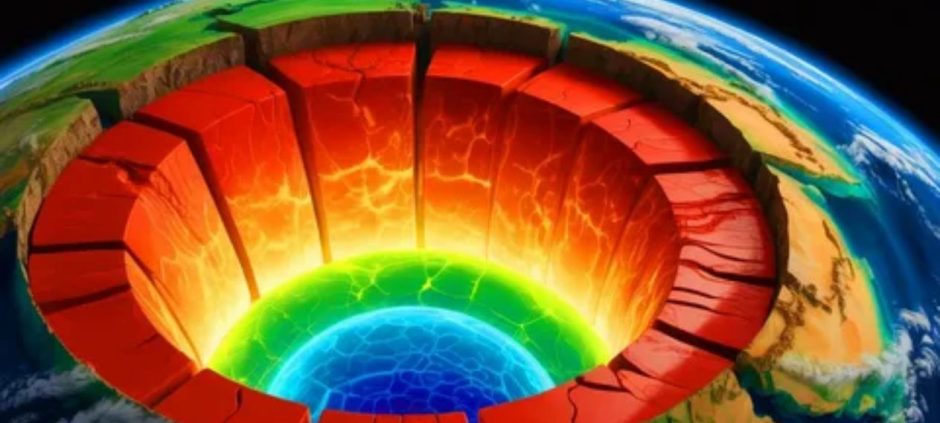
Researchers from the Guangzhou Institute of Geochemistry, part of the Chinese Academy of Sciences, conducted high-pressure, high-temperature experiments that simulated conditions more than 660 kilometers beneath Earth’s crust. They found that bridgmanite, the dominant mineral in the lower mantle, can trap and store enormous amounts of water during the early magma ocean phase of Earth’s formation.
“This study provides evidence that early Earth’s deep mantle was not dry, it could have acted as a vast water reservoir,” scientists said, challenging earlier beliefs that most primordial water was lost to space or remained on the surface
The experiments recreated temperatures up to 4,100 °C using diamond anvil cells and laser heating to mimic early Earth’s extreme interior conditions. Surprisingly, bridgmanite’s ability to lock water increased with temperature, meaning that early mantle minerals may have stored up to 0.08 to 1 times the volume of all modern oceans. Over geological time, this stored water likely migrated toward the surface through volcanic activity, contributing to the oceans and atmosphere essential for life.
Scientists believe this deep mantle water played a crucial role in making Earth habitable, influencing internal circulation, plate tectonics, and long-term water cycling that supports life today.
The discovery also resonates beyond Earth sciences. In Pakistan, large-scale water management projects such as Punjab’s plan to build the largest wastewater treatment plant are part of efforts to secure sustainable water resources at the surface, a modern complement to the planet’s ancient, hidden water cycles.
Researchers hope the new findings will lead to deeper explorations of Earth’s internal processes and improve models of water distribution on rocky planets, insights that could help identify other habitable worlds in the universe.