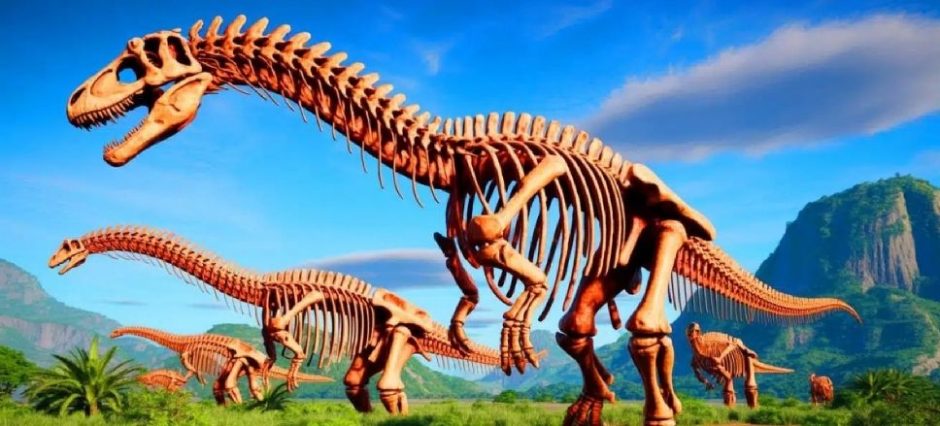
Brazilian paleontologists have uncovered a new species of giant dinosaur, Dasosaurus tocantinensis, shedding light on prehistoric connections between South America, Africa, and Europe around 120 million years ago. The discovery reinforces evidence that land routes once linked these continents, allowing the dispersal of large dinosaur species across vast distances.
The fossils, among the largest ever found in Brazil, were excavated in 2021 during infrastructure work near Davinopolis in the northeastern state of Maranhao. The research was led by Elver Mayer from the Federal University of the Sao Francisco Valley and included contributions from paleontologists such as Leonardo Kerber of the Federal University of Santa Maria (UFSM).
Key remains include a femur measuring approximately 1.5 meters (59 inches), which allowed scientists to estimate the dinosaur’s total length at around 20 meters. “As the excavation progressed, the sheer size of the femur became apparent,” said Kerber. “This confirms Dasosaurus is among the largest dinosaurs ever identified in Brazil.”
Analysis of the fossils indicates that Dasosaurus tocantinensis is closely related to Garumbatitan morellensis, a species previously described in Spain. Experts believe their ancestors originated in Europe and dispersed to what is now South America about 130 million years ago, likely passing through northern Africa before the Atlantic Ocean fully separated the continents.
The dinosaur’s name honors the region where it was discovered, referencing the Tocantins River, whose eastern margins lie close to the fossil site. The findings were formally described this month in the Journal of Systematic Palaeontology, adding an important piece to the puzzle of dinosaur evolution and biogeography in the early Cretaceous period.
This discovery not only highlights Brazil’s rich paleontological heritage but also provides critical evidence about ancient continental connections and the migration of giant dinosaur species across prehistoric landmasses, offering fresh insights into global dinosaur distribution more than 100 million years ago.
Read more: Fossilized Feces and Vomit Reveal New Insights into Dinosaurs’ Dominance on Earth