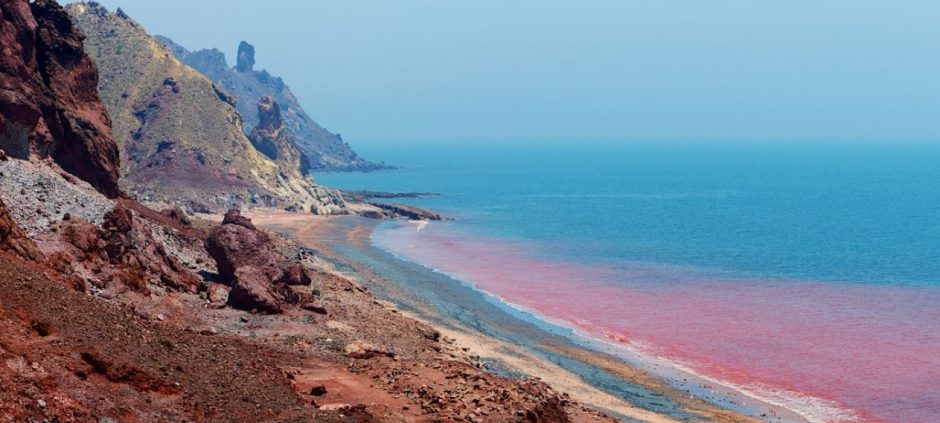
A wild viral video showing blood-red scenes covering Iran’s Hormuz Island coastline after a heavy rainstorm has captured global attention, prompting curiosity and scientific explanations for the striking phenomenon.
The dramatic transformation unfolded after recent torrential rainfall drenched the island in the Strait of Hormuz, washing iron-rich soil and mineral sediments from the hills down to the beaches and shallow waters. As the rainwater flowed through the distinct red soil, rich in iron oxide and hematite, it stained both the shoreline and adjacent sea with deep crimson hues, creating scenes that resemble rivers of blood.
Scientists and geologists have been quick to clarify that the phenomenon is entirely natural. Hormuz Island’s geology includes a mosaic of evaporites, volcanic layers, and iron-packed rock that appears brilliantly colored when exposed to moisture. When rainwater dissolves and carries these mineral particles, especially hematite, they reflect red wavelengths of light, resulting in the vivid red colour seen across the beaches and water.
Despite its eerie appearance, experts stress that this “blood-red rain” is harmless to both humans and the ecosystem as there is no sign of pollution or toxic compounds involved. In fact, similar occurrences have been spotted on the island during heavy rains, and they draw geologists, photographers, and travellers eager to witness this rare natural spectacle.
Local social media posts and netizens have buzzed with comparisons to cosmic phenomena, some even linking the intensity of red to celestial events. For fascinating visuals and global lunar event context, here is a related coverage on the 2025 Blood Moon Lunar Eclipse. However, it’s a different but equally dramatic natural display that captivated skywatchers worldwide.
As the rain-washed red sediments gradually settle and tides dilute the color, the island’s shores are expected to return to their usual hues, but not before creating one of nature’s most unforgettable and photogenic moments.