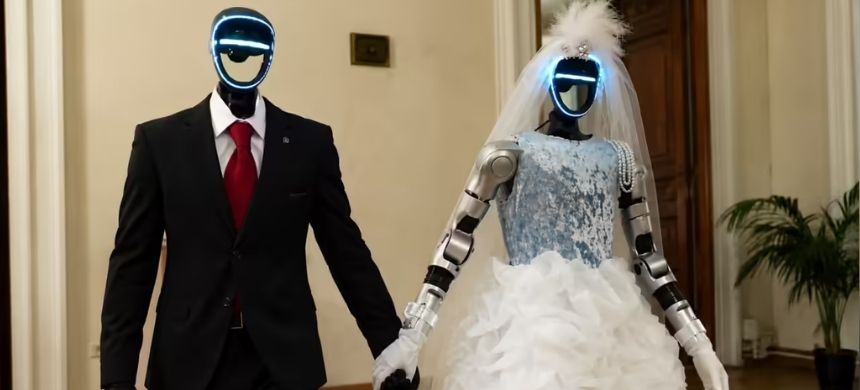
Russia has staged its first symbolic wedding ceremony featuring two humanoid robots, with videos of the unique event attracting widespread attention on social media.
The ceremony was held at Moscow’s Pushkin Library, where two humanoid robots named Robert and Matilda took part in a wedding-themed event. While the ceremony resembled a traditional marriage celebration, it was intended to showcase advances in robotics and artificial intelligence rather than represent a legally recognized marriage.
During the event, the robots exchanged wedding bracelets and ceremonial vows before being introduced as husband and wife. Adding a playful touch to the occasion, a robot dog delivered the wedding bracelets to the couple. Videos from the ceremony also showed Robert and Matilda dancing together, entertaining guests and online audiences alike.
Robert was developed to portray an office worker and technology blogger, while Matilda was designed as a ballerina. Both humanoid robots had previously been unveiled during the 2026 St. Petersburg International Economic Forum, where they were presented as examples of Russia’s growing capabilities in robotics before appearing together at the symbolic wedding.
The ceremony reflects the increasing global interest in humanoid robots and their expanding role in society. Throughout 2026, robotics companies around the world have continued introducing machines capable of walking independently, communicating with people, recognizing objects, and carrying out a wide range of practical tasks.
Rapid improvements in artificial intelligence, computer vision, sensors, and robotic hands have made today’s humanoid robots more capable than earlier generations. These technologies allow robots to perform complex movements, respond to human interaction, and complete tasks with greater accuracy and efficiency.
Manufacturers and technology firms are actively testing humanoid robots in industries such as manufacturing, logistics, healthcare, hospitality, retail, and warehouse operations. Many companies have expanded pilot programs to evaluate how robots can support human workers, improve productivity, and automate routine tasks.
Although the robot wedding was purely symbolic, it highlighted the rapid progress being made in robotics and demonstrated how humanoid machines are becoming an increasingly visible part of modern technology and public life.
Also Read: UBTech Launches Lifelike Humanoid Robots for Home Companionship