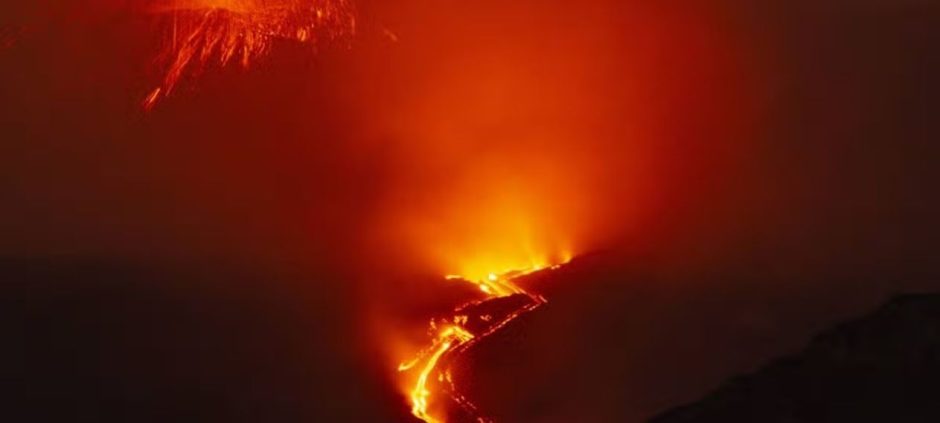
Mount Etna erupted again on Sunday, sending thick clouds of volcanic ash into the sky over Sicily and causing major disruptions to air travel at Catania Airport.
Catania Airport announced that airspace around the airport was heavily restricted until 7:00 p.m. local time, affecting both departures and arrivals. Local media reported that all incoming flights were cancelled as volcanic ash spread across parts of Sicily, while flight tracking data also showed widespread cancellations.
Italy’s national airline, ITA Airways, confirmed that all flights arriving at and departing from Catania Airport would either be cancelled or rescheduled due to the ongoing volcanic activity and safety concerns.
According to Italy’s National Institute of Geophysics and Volcanology (INGV), ash emissions began early Sunday from a vent near Mount Etna’s summit before intensifying later in the morning. The eruption produced an ash column rising approximately 1.5 kilometers above the crater, with forecasters expecting the ash cloud to continue drifting southward.
The latest eruption follows a red alert issued by Italy’s Department of Civil Protection after volcanic activity intensified on July 2. Mount Etna has now been erupting for nine consecutive days, with lava flows, ash emissions, and volcanic tremors continuing across the region.
Standing around 3,300 meters (10,800 feet) above sea level on Sicily’s eastern coast, Mount Etna is Europe’s largest active volcano and one of the most active volcanoes in the world. It frequently experiences eruptions that produce lava flows, ash clouds, and powerful summit explosions.
Also read: Cold Lava Flow Ravages Philippine Village Following Kanlaon Volcano Eruption