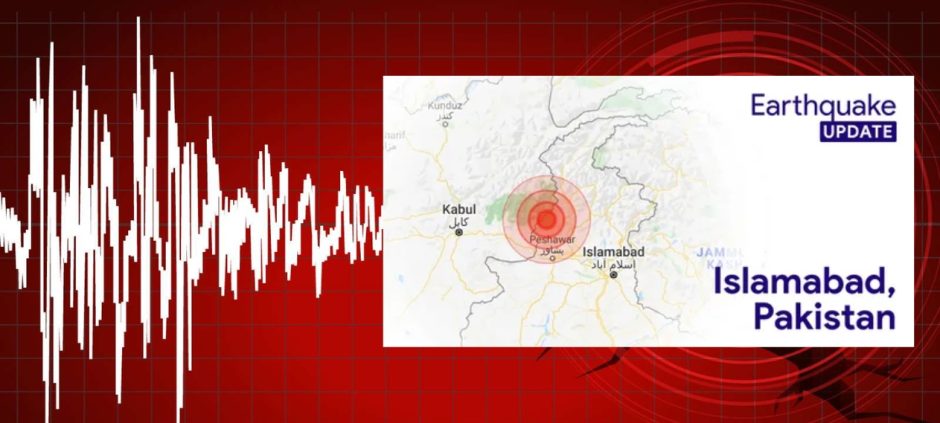
A 5.8-magnitude earthquake jolted Islamabad and several northern parts of Pakistan on Monday morning, January 19, 2026. The tremors occurred at approximately 10:21 AM PKT, causing immediate panic as residents in the federal capital rushed out of homes and high-rise offices.
According to the National Seismic Monitoring Centre (NSMC), the quake struck at a shallow depth of 10 kilometers. Because the depth was so shallow, the shaking felt intense at the surface. Meanwhile, data from the United States Geological Survey (USGS) slightly differed, measuring the quake at 5.9 magnitude with a depth of 35 kilometers.
Areas Affected by the Tremors
The impact of the earthquake was widespread across the region. Strong vibrations were reported in:
- Islamabad and Rawalpindi: The twin cities saw major evacuations from commercial buildings.
- Khyber Pakhtunkhwa: Tremors were felt in Swat, Peshawar, and Abbottabad.
- Gilgit-Baltistan: Reports of shaking came in from Hunza and surrounding valleys.
Emergency services and the National Disaster Management Authority (NDMA) are on high alert. Fortunately, there have been no immediate reports of casualties or major structural damage. Authorities are continuing to monitor remote mountainous areas for any potential landslides.
Scientific Context and History
The earthquake in Islamabad today highlights Pakistan’s vulnerability to seismic activity. The country sits where the Indian and Eurasian tectonic plates meet. This intersection frequently causes tectonic shifts, leading to the tremors felt today.
This event follows a series of recent quakes, including a 5.2-magnitude tremor that struck near Karachi in late 2025. Historically, the region has faced devastating events, such as the 2005 quake that killed over 73,000 people. Experts note that shallow quakes, like today’s, often cause more surface-level panic even if they are moderate in magnitude.
Public Safety and Aftershocks
Officials advise citizens to remain vigilant as aftershocks may occur throughout the day. People are encouraged to stay away from glass windows and tall, fragile structures.
Local administrations have been tasked with inspecting public infrastructure to ensure building safety. While the initial threat has passed, staying informed through official channels remains crucial for public safety.
While emergency teams monitor the seismic activity, the country is already stretched thin; for instance, the Gul Plaza Fire was finally brought under control after 36 hours following a tragic incident in Karachi.