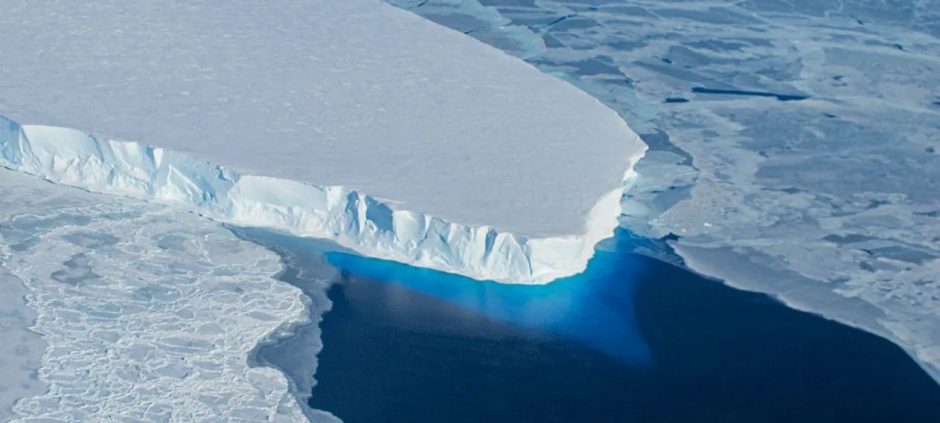
Scientists monitoring Antarctica’s Thwaites Glacier — often dubbed the “Doomsday Glacier” — say the ice feature is weakening more rapidly due to structural cracking and fracturing than from surface melting alone. New research from the International Thwaites Glacier Collaboration and related scientific efforts shows that expansive cracks across the glacier’s floating ice shelf are growing faster than previously expected, undermining the shelf’s ability to hold back the massive inland ice behind it.
The Thwaites Glacier, located in West Antarctica, is one of the continent’s largest and most vulnerable glaciers. It plays a crucial role in holding back ice that lies well below sea level — a configuration that makes it especially susceptible to collapse if its supporting ice shelf continues to deteriorate. Recent satellite data reveal that cracks in the ice shelf have more than doubled in total length over the past two decades, signaling that the glacier’s integrity is weakening.
Scientists explain that these cracks are not just surface features but are linked to deeper processes that accelerate the glacier’s retreat. While ocean-driven melting remains a key force — particularly warm water circling underneath the floating ice — the cracks themselves create stress points that allow water to penetrate deeper, further destabilizing the glacier from below and above.
The glacier’s ice shelf used to be anchored to seafloor ridges that helped slow down the ice flow. But as these pinning points weaken and crack networks expand, the shelf is gradually losing its grip on the bedrock, reducing the resistance against the inland ice moving seaward. This dynamic suggests that the glacier’s collapse could accelerate even if overall melt rates remain slower than some models previously predicted.
The implications of Thwaites Glacier’s weakening are significant for global sea levels. If the glacier were to collapse entirely, it could contribute roughly 65 centimeters to sea-level rise, and potentially trigger further instability in adjacent glaciers, leading to even larger increases over time. This potential makes Thwaites one of the most closely watched glaciers on the planet.
Researchers emphasize that understanding how cracks develop and spread is now just as important as measuring melt rates. These structural changes, driven by both ocean interactions and internal stresses, may dictate how quickly Thwaites continues to lose ice and what that means for coastal cities and ecosystems around the world.
Also read: Kuwait Bans Extra Charges on Debit and Credit Card Payments