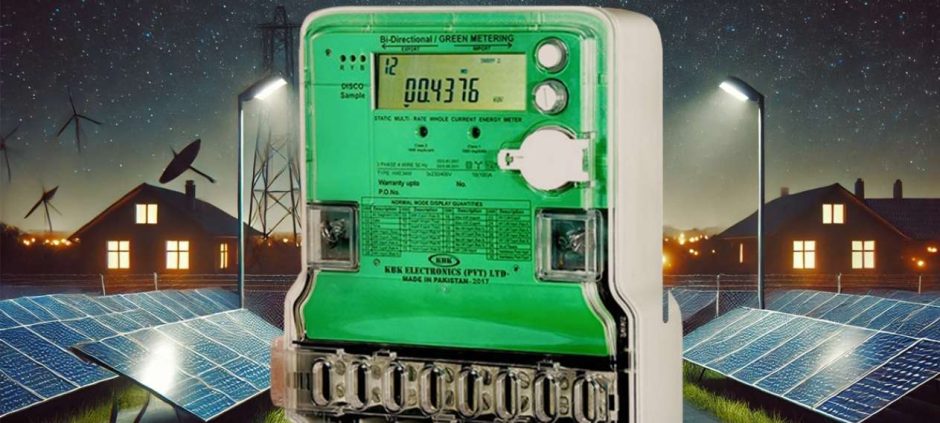
Pakistan has officially ended its net metering regime, significantly reshaping the economics of rooftop solar power across the country. The National Electric Power Regulatory Authority (NEPRA) has notified the Prosumer Regulations 2026, replacing the long-standing unit-for-unit electricity adjustment system with a new net billing framework. Under the revised policy, small power producers will receive a lower rate for surplus electricity exported to the grid while continuing to pay standard consumer tariffs for electricity drawn from it.
The newly notified regulations effectively suspend the Net Metering Regulations 2015 and introduce a system where electricity generated through distributed solar, wind, or biogas facilities of up to one megawatt will be settled through net billing. This means that instead of offsetting consumed units against exported units, billing will now be calculated at the end of each 30-day billing cycle based on actual electricity supplied to and taken from the grid.
Under the new framework, the current buyback rate of Rs. 25.9 per unit for solar net metering consumers is expected to be reduced to around Rs. 11 per unit. At the same time, distribution companies (Discos) will charge consumers the applicable retail tariff for grid electricity, which in some cases can reach as high as Rs. 50 per unit. This sharp difference has raised concerns among prospective rooftop solar users about reduced financial returns.
NEPRA clarified that the new policy will not apply to existing net metering consumers during the validity of their current contracts. However, Discos have been authorised to either terminate contracts or shift consumers to the new net billing framework once those contracts expire. The regulator has also limited the net metering contract period to five years, with an option for renewal for another five-year term.
According to the regulations, electricity exported to the national grid will now be purchased at the National Average Energy Price, while consumers will be billed for electricity consumed at prevailing tariffs. Payments for surplus electricity will be made separately, ending the one-to-one unit compensation model. Biogas-based prosumers have also been brought under the same regulatory structure.
NEPRA stated that eligible consumers include residential, commercial, industrial, agricultural, and general services users connected at 400V or 11kV, subject to interconnection approval by the relevant Disco. The authority has also granted itself special powers to revise purchase rates during agreements, issue binding directions, demand operational data, and impose penalties where necessary.
The regulator said the reforms are aimed at addressing financial losses, tariff distortions, and grid instability caused by rapid rooftop solar adoption. Pakistan’s rooftop solar capacity has now reached an estimated 6,000 megawatts, largely concentrated in urban residential, commercial, and industrial sectors.
While solar adoption has reduced daytime grid demand, it has also eroded utility revenues. In FY2024 alone, electricity sales dropped by 3.2 billion units, costing Discos nearly Rs. 101 billion. These losses were passed on to remaining consumers, adding around Rs. 0.9 per kilowatt-hour to tariffs.
Regulators argue that net metering created a regressive impact by shifting fixed grid costs onto non-solar users, as wealthier households reduced their billed consumption. Power Division projections warn that without reform, lost grid sales could reach 18.8 billion units by FY2034, with a cumulative impact of Rs. 545 billion and a possible tariff increase of Rs. 5 to Rs. 6 per unit.
Operational challenges have also increased, particularly during winter when demand falls to 8,000–9,000 megawatts while solar generation peaks during daylight hours. To manage these risks, NEPRA has capped distributed generation at one megawatt, restricted capacity to sanctioned load, and barred new connections where transformer utilisation exceeds 80 percent.