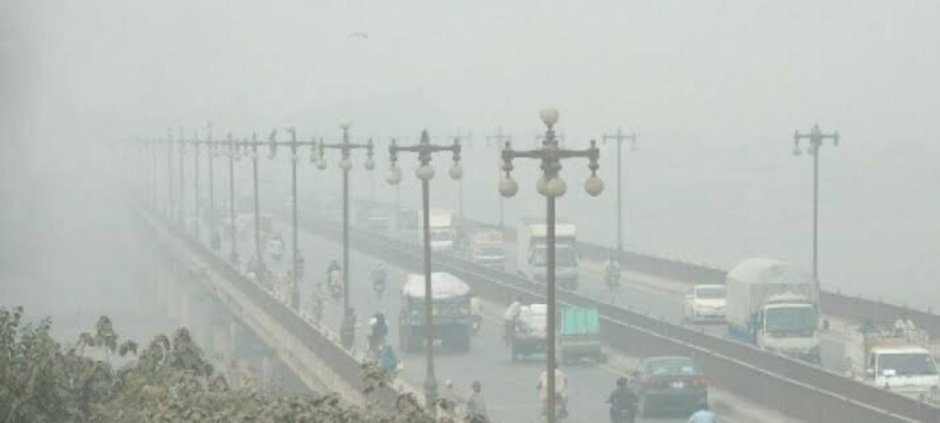
Thick smog engulfed several Pakistani cities on Wednesday, November 11, as air quality deteriorated to hazardous levels across parts of Punjab.
According to IQAir, Lahore once again ranked as the world’s most polluted major city, recording an Air Quality Index (AQI) of 425 between 11am and noon.
The reading placed Lahore firmly in the hazardous category, raising concerns about the health and safety of residents as polluted air continued to affect daily life.
Lahore Tops Global Pollution Rankings
IQAir’s global air quality ranking placed Lahore at the top of the list of the world’s most polluted major cities during the specified period on Wednesday.
The city’s AQI reached 425 between 11am and noon, significantly exceeding the threshold at which air pollution is classified as hazardous.
An AQI reading above 300 falls into the hazardous category, indicating that polluted air can pose serious health risks to the general population.
The latest ranking highlights the continuing severity of Lahore’s air pollution problem, with thick smog reducing visibility and affecting conditions across the city.
Two Punjab Cities Record AQI of 500
Air quality readings from the Punjab government’s monitoring system showed even higher pollution levels in two other cities.
According to the provincial government’s data for the same hour, Muzaffargarh and Nankana Sahib both recorded an AQI of 500.
These readings indicate extremely poor air quality and highlight that the pollution crisis is not limited to Lahore.
Several areas across Punjab continue to experience unhealthy atmospheric conditions, with residents facing exposure to heavily polluted air.
What Does an AQI of 425 Mean?
The Air Quality Index is used to communicate the level of air pollution and its potential effects on human health.
Under the AQI scale, readings above 300 are classified as hazardous. At this level, everyone may be affected by air pollution, while people with existing respiratory or cardiovascular conditions can face additional risks.
Lahore’s reading of 425 therefore represents a serious air quality situation rather than an ordinary seasonal increase in pollution.
An AQI of 500, as recorded in Muzaffargarh and Nankana Sahib, is at the upper end of the commonly used AQI scale.
Residents Face Continued Exposure to Smog
The hazardous conditions have renewed concerns about public exposure to polluted air, particularly among children, older people and individuals with respiratory problems.
Prolonged exposure to heavy smog can irritate the eyes and throat and worsen breathing difficulties. People with asthma and other respiratory conditions may be especially vulnerable.
Residents are generally advised to reduce unnecessary outdoor activities during periods of severe pollution, avoid strenuous exercise outside and use a well-fitting particulate-filtering mask when outdoor exposure cannot be avoided.
Keeping windows closed when outdoor pollution is particularly high and following official air quality updates can also help reduce exposure.
Pollution Remains a Major Challenge for Punjab
The latest readings underline the scale of Punjab’s recurring smog problem.
Lahore’s position at the top of IQAir’s global ranking, alongside AQI readings of 500 in Muzaffargarh and Nankana Sahib, shows that hazardous air quality is affecting multiple parts of the province.
The figures also highlight the importance of continuous air quality monitoring and measures to reduce pollution.
Authorities and residents will be closely watching upcoming readings to determine whether air quality improves or remains at dangerous levels.
Also read: Lahore Tops Global Pollution Rankings as Smog Worsens