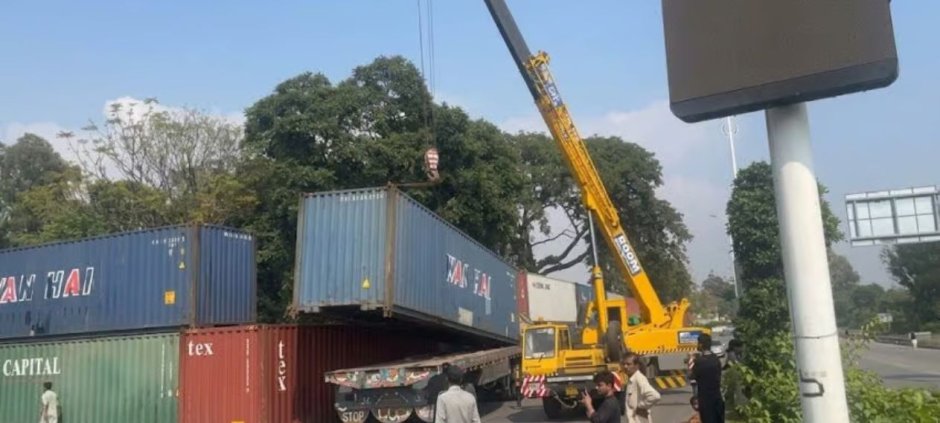
Islamabad has started removing shipping containers placed across major roads during Pakistan Tehreek-e-Insaf’s (PTI) protest campaign, bringing hope of relief for commuters, transporters and businesses after weeks of disruption. The development comes as the federal government’s move to impose governor’s rule in Khyber Pakhtunkhwa adds a new dimension to the political situation surrounding PTI’s planned long march towards the capital.
Islamabad Inspector General of Police Captain (r) Sohail Chaudhry reportedly ordered the removal of containers from roads across the city on October 12, 2026. According to police sources, the clearance process has begun. However, the time required to remove all barriers from the capital’s roads remains unclear.
The containers were deployed as part of security arrangements ahead of PTI’s protest demanding the release of former prime minister Imran Khan. Key roads, entry and exit points and routes leading towards the Red Zone were blocked to prevent protesters from reaching sensitive government buildings.
Thousands of Containers Disrupted Daily Life
Reports have estimated that between 1,500 and 2,000 containers, or even more, were used in Islamabad’s security arrangements. Large-scale deployment was reported during September, particularly between September 18 and 23.
Some containers were reinforced with sand, welded together or secured through other measures to make them more difficult to move. These arrangements created major obstacles for people travelling to work, students, businesses and transport operators.
The restrictions continued for weeks, affecting routine movement across the capital. Businesses faced difficulties receiving goods, while commuters had to deal with longer journeys and changing routes. The disruption also increased pressure on transport services and added costs for companies moving cargo.
The extensive use of containers prompted criticism, with some people referring to Islamabad as “Containerabad” and “Containeristan” because of the roadblocks.
Transporters Face Financial Losses
The deployment also created problems for container owners and transport companies. Reports indicated that loaded vehicles had been taken for security duties, leading to disputes over rental payments and compensation.
Transporters faced additional expenses while their vehicles were unavailable for normal commercial operations. Delays in cargo movement also affected supply chains, with reports linking transport disruption to congestion in other parts of the country, including Karachi.
Authorities had previously taken steps to release some vehicles carrying essential and perishable goods. Questions over payments to container owners and the cost of the overall security operation also remained a concern.
Estimates of the total expenditure on container rentals, security personnel and related arrangements have varied considerably, ranging from hundreds of millions of rupees to more than Rs1 billion. The final cost has not been conclusively established in the information available.
The latest removal order could help restore normal traffic flow, although relief will depend on how quickly authorities clear the affected routes.
How the PTI Long March Led to Roadblocks
The container arrangements were linked to PTI’s planned march towards Islamabad, which was initially scheduled for September 27 before being postponed to October 4. The party described the postponement as a strategic decision.
The protest subsequently moved forward in phases from Khyber Pakhtunkhwa, with Chief Minister Sohail Afridi among the prominent political figures associated with the mobilisation.
Negotiations between PTI and the federal government failed to resolve major differences. These included disagreements over access to Imran Khan and cooperation on counterterrorism efforts.
In response, authorities increased security across Islamabad. Personnel were reportedly brought in from Punjab and Sindh, while roadblocks were placed at important entry points. Restrictions under Section 144 were also part of the measures taken to control public gatherings and prevent protesters from reaching sensitive locations.
Although the arrangements were intended to prevent a major security breach, they also created prolonged difficulties for residents and businesses that had no direct involvement in the political dispute.
Federal Government’s Move on Khyber Pakhtunkhwa
The situation has also developed alongside the federal government’s decision to impose governor’s rule in Khyber Pakhtunkhwa. President Asif Ali Zardari reportedly approved the federal cabinet’s recommendations following a meeting chaired by Prime Minister Shehbaz Sharif.
The federal government cited security concerns and terrorism-related challenges in support of the move. It also alleged that the provincial administration had not taken sufficient responsibility for counterterrorism efforts.
The reported constitutional basis for the decision involves Articles 232 and 234 of Pakistan’s Constitution. Article 232 deals with emergency provisions under specified circumstances, while Article 234 addresses situations in which the constitutional machinery of a province is considered to have failed.
These provisions concern different constitutional circumstances and should not be treated as interchangeable. The legal basis and implementation of any such action depend on the applicable constitutional requirements and official measures.
The political implications of governor’s rule could affect relations between the federal and provincial governments, particularly as PTI continues to oppose the federal administration. However, the removal of containers is a separate administrative development, and it does not by itself establish that all political tensions or the possibility of future protests have ended.
Will Islamabad Return to Normal?
The start of the clearance operation is an important development for Islamabad residents who have faced weeks of road closures and delays. Removing the barriers could improve access to workplaces, markets, government offices and major transport routes.
Businesses may also benefit from smoother deliveries and fewer transport delays. For container owners and transporters, however, questions over compensation and the cost of keeping vehicles away from their regular work may remain unresolved.
Authorities will need to complete the removal process and restore traffic arrangements across affected routes. Until all major barriers are cleared, some commuters may continue to face disruption.
For now, the reported order offers hope that Islamabad can gradually return to normal movement after weeks of security restrictions. The wider political situation, including relations between PTI and the federal government and developments in Khyber Pakhtunkhwa, will remain important factors in determining whether further disruptions occur.
Also read: Islamabad Police to Pay Rent for Seized Containers