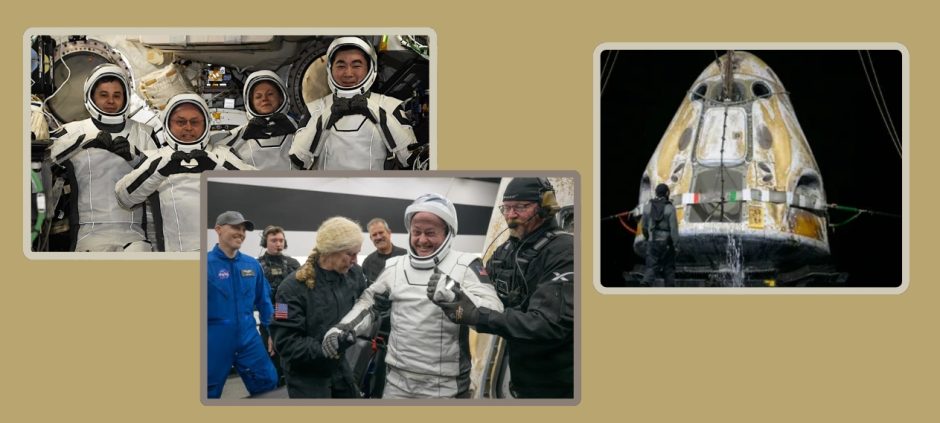
The SpaceX Dragon Endeavour spacecraft safely returned to Earth on Thursday, January 15, 2026. This landing marked the end of the Crew-11 mission. The spacecraft splashed down in the Pacific Ocean near San Diego, California, at 3:41 a.m. ET.
The International Crew-11 returns early following the first medical evacuation in the history of the International Space Station (ISS). NASA shortened the mission by nearly one month. This decision was made to address a medical concern involving one of the four crew members.
Details of the Early Return
The crew spent 167 days in space before undocking on Wednesday, January 14. NASA officials stated that the health issue was stable and not an urgent emergency. However, the ISS lacks the specific medical tools needed for a full diagnosis and treatment.
To protect the astronaut’s privacy, NASA has not released the name of the individual or the specific illness. Because the Dragon capsule acts as a shared “lifeboat,” all four members had to return together.
The Returning Crew
The international team includes experts from three different space agencies:
- Zena Cardman (NASA): The mission commander completed her first spaceflight.
- Mike Fincke (NASA): The veteran pilot has now spent 549 days in space over four missions.
- Kimiya Yui (JAXA): A Japanese mission specialist finishing his second flight.
- Oleg Platonov (Roscosmos): A Russian mission specialist completing his first trip to orbit.
Current Status of the ISS
The International Crew-11 returns at a time when the ISS will operate with a smaller crew. Only three people remain on the station: Sergey Kud-Sverchkov, Sergey Mikayev, and Chris Williams.
The departing crew was taken to a San Diego hospital for routine checks after landing. They are expected to fly to Houston on Friday, January 16. NASA and SpaceX may move up the launch of Crew-12 to February 15. This would bring the station back to its full seven-person capacity.
Despite the early departure, NASA described the mission as a major success. The crew supported hundreds of scientific experiments during their stay. These included studies on liver tissue engineering and edge computing technologies.
As we study life on the ISS, discoveries are also emerging about other celestial bodies. Did you know that the Moon is Feeding and Growing, Says Latest Scientific Research? This report shows there is still much to learn about our solar system.