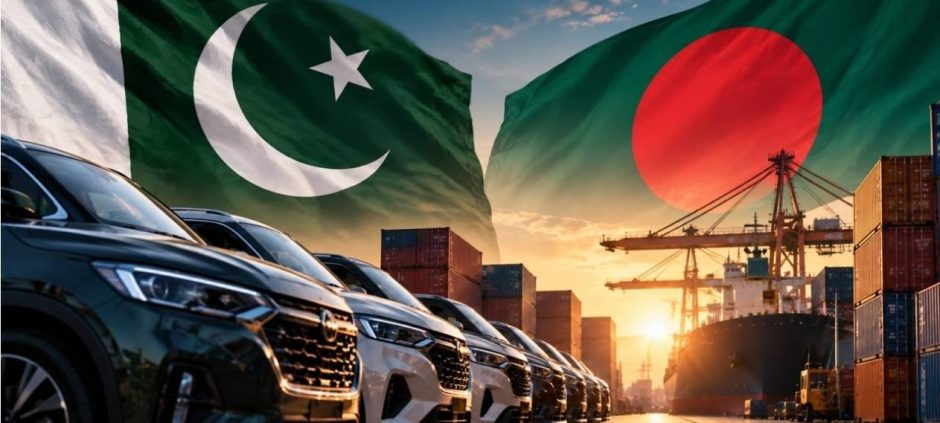
Pakistan is set to begin trial exports of locally assembled vehicles to Bangladesh this month. The move could open a new market for Pakistan’s automotive industry.
Around 100 vehicles are planned for shipment during 2026 under an agreement between a Pakistani automaker and a Bangladeshi business group. The initial exports are expected to begin in September.
The two sides signed a memorandum of understanding in July. The agreement covers the potential export of up to 5,000 vehicles to Bangladesh.
Under the initial arrangement, 100 vehicles will be exported on a trial basis during 2026. Larger-scale commercial exports are expected to begin next year, subject to the success of the initial shipments.
Two globally recognized vehicle models produced in Pakistan will be exported to Bangladesh this month. The vehicles are assembled in Pakistan through a partnership with China’s SAIC Motor.
The development marks a new step in cooperation between the Pakistani and Bangladeshi automotive industries. It could also help Pakistani manufacturers establish a stronger presence in the Bangladeshi market.
According to the exporting company’s CEO, Jiang Qiang Shao, the two models had previously been exported to Bangladesh from China. The company later explored the possibility of shifting the export model to Pakistan.
Following discussions with SAIC Motor’s headquarters, the company received support to move from completely built-up vehicle exports from China to completely knocked-down exports from Pakistan.
Under the CKD model, vehicles are shipped in parts for assembly in the destination country. This approach could offer financial advantages to the Bangladeshi distributor by reducing import duties.
The shift could also provide Pakistan with an opportunity to develop a sustainable automotive export business. Local assembly and exports could create new opportunities for manufacturers, engineers and other industry workers.
The Pakistani automaker will also provide technical support to its Bangladeshi partner. This will include guidance on vehicle assembly, general assembly and quality control procedures.
A local engineering team is expected to travel to Bangladesh. The team will provide technical guidance and engineering services during the development of the new export operation.
Shao said Pakistan could gradually expand its automotive exports because of its cost advantages and skilled workforce. He said the country has the potential to build a stronger position in regional vehicle markets.
The Bangladesh agreement could also have significance beyond vehicle exports. According to Shao, the business model could eventually create opportunities for technology and engineering services.
The company aims to establish sustainable automotive exports from Pakistan. If the trial shipments perform well, the arrangement could support larger export volumes in the coming years.
The development comes as Pakistan seeks to expand its export base and reduce reliance on traditional export sectors. Automotive exports could provide an additional source of foreign exchange while supporting industrial development.
The initial shipment of 100 vehicles will therefore serve as an important test for the new business model. Its success could determine the pace of future exports to Bangladesh.