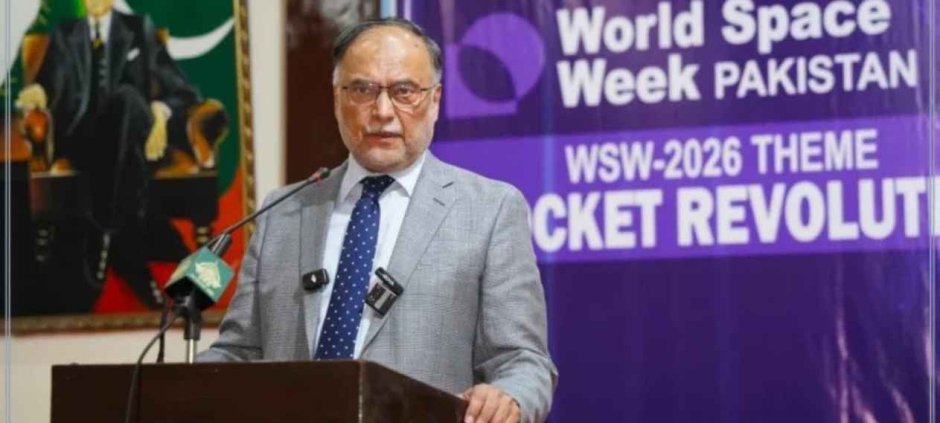
Pakistan has announced plans to send its first astronaut on a space mission from a Chinese space centre on November 25. Federal Minister for Planning Ahsan Iqbal shared the announcement during the closing ceremony of World Space Week 2026 in Narowal.
The event was held in Narowal for the first time with support from the Space and Upper Atmosphere Research Commission (SUPARCO). It aimed to promote awareness of space science, scientific research, and modern technology among young people.
Ahsan Iqbal also announced that Pakistan had set a target of landing on the Moon by 2035. He said cooperation with China would help the country advance its space exploration efforts.
The announcements highlighted the government’s stated plans to strengthen scientific research and expand opportunities in advanced technology.
Pakistan Sets Moon Landing Target for 2035
Addressing the ceremony, Iqbal highlighted the importance of international cooperation in achieving space exploration goals. He said collaboration with China could help Pakistan reach new milestones in space science.
The proposed Moon landing target represents a long-term ambition for the country’s space programme. Achieving it would require scientific research, technical development, and continued cooperation.
Iqbal also discussed the growing importance of space technology in everyday life. He said it plays a role in agriculture, communications, climate monitoring, education, and national security.
According to the minister, investment in space research can support future development and scientific discoveries. It can also help expand human knowledge and improve the use of modern technologies.
World Space Week Promotes Scientific Awareness
World Space Week 2026 provided a platform to encourage young people to explore science and technology. The event focused on developing scientific curiosity and interest in research.
Iqbal referred to the teachings of the Holy Quran while discussing the importance of understanding the universe. He said these teachings encourage people to reflect on creation and seek knowledge.
The minister also highlighted the historical contributions of Muslim scientists to astronomy and scientific research. He stressed that Pakistan needed to strengthen its position in education, innovation, and knowledge development.
He encouraged young people to pursue scientific learning and explore emerging fields. These efforts, he said, could help prepare future generations for technological challenges.
University of Narowal to Host Pakistan’s First Space Museum
Iqbal praised the achievements of the University of Narowal during his address. He referred to its first-place finish at the Islamabad Science Festival as an example of youth potential.
The minister said Pakistani students were demonstrating their abilities through education and research. He also highlighted students who had overcome financial difficulties to pursue higher education.
To promote further interest in space science, Iqbal announced plans to establish Pakistan’s first space museum at the University of Narowal.
The proposed museum aims to increase public awareness of space exploration and inspire students to study scientific subjects. It could also provide an opportunity for young people to learn about space technology.
Government Highlights Opportunities in Advanced Technology
The government aims to provide young people with greater access to emerging scientific disciplines. These opportunities could help students develop skills in research, innovation, and advanced technology.
The space programme and proposed museum form part of the broader effort to encourage scientific learning. However, progress will depend on the implementation of announced plans and the development of necessary technical capabilities.
In other related news also read Shehbaz Sharif Announces Danish Schools Expansion Across Pakistan
Pakistan’s proposed astronaut mission and 2035 Moon landing target have placed space exploration in focus. The initiatives also highlight the importance of education, international cooperation, and investment in scientific research.