The Water and Sanitation Agency (WASA) Lahore and DynaSys Networks have marked the first anniversary of Pakistan’s first citywide LoRaWAN-based automated water metering system, a project designed to modernise water management through digital technology.
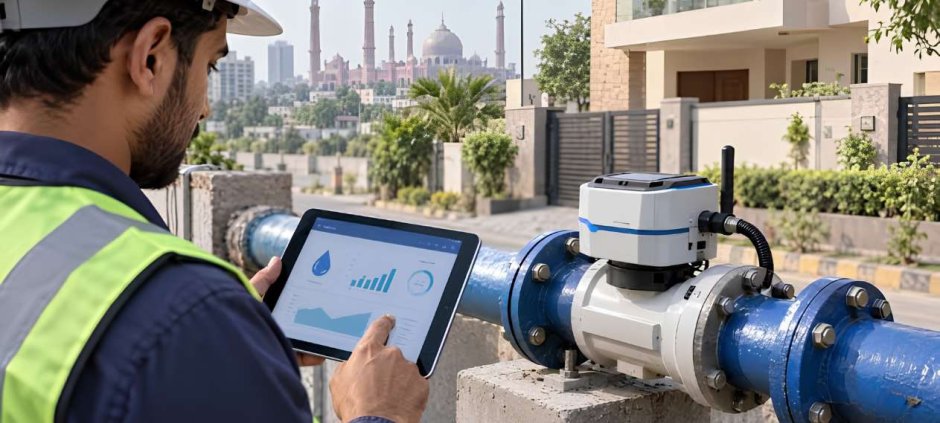
The initiative has introduced smart water meters, real-time monitoring and remote valve control, allowing the agency to collect water consumption data without relying entirely on traditional house-to-house manual readings.
According to the companies, the project has crossed 1,100 active smart water meters since its initial implementation in Johar Town, Lahore.
Smart Water Metering Project Started in Johar Town
The first phase of the project was planned and implemented in Johar Town between July and September 2025.
WASA Lahore partnered with DynaSys Networks, a Pakistani developer and operator of low-power wide-area network (LPWAN) Internet of Things (IoT) solutions, to establish the automated water metering infrastructure.
The system uses LoRaWAN technology, which enables connected devices to transmit data over long distances while consuming relatively little power.
Following the successful implementation of the initial phase, more than 1,100 smart water meters are now operational, according to the companies.
The project is intended to establish a digital foundation for improving water utility management and monitoring consumption across the city.
Centralised Command Centre Enables Real-Time Monitoring
A key feature of the initiative is a centralised command-and-control centre that collects information from connected water meters.
Through the system, WASA Lahore can remotely monitor water consumption patterns and access meter data without depending solely on manual readings.
The platform also provides remote valve control for individual water meters, giving the agency additional control over its water distribution infrastructure.
This technology is designed to help WASA identify unusual consumption patterns, improve monitoring and respond more efficiently to potential problems.
By reducing reliance on manual data collection, the system could also help address some of the delays and inefficiencies associated with traditional water meter management and billing processes.
AI-Ready Technology to Help Reduce Water Losses
The LoRaWAN-based network provides an automated system for identifying irregularities and potential faults in the water supply infrastructure.
According to the project details, the DynaSys IoT platform can detect relevant anomalies and automatically generate alerts at the command-and-control centre.
These notifications allow WASA Lahore’s maintenance teams to investigate problems and take action before they develop into major service disruptions or cause significant water losses.
The technology is also designed to improve asset management by giving the agency access to more timely information about its water infrastructure.
The platform’s AI-ready architecture provides a foundation for further digital improvements, although the source does not specify any particular AI-powered features currently in operation.
WASA Lahore Highlights Benefits of Digital Water Management
Mudasser Javaid, Director of WASA Lahore, described the initiative as a model for other water utilities across Pakistan.
He said digitising water infrastructure could improve service delivery while supporting more precise and accountable management of the country’s water resources.
Javaid also highlighted the importance of data-driven governance in developing a more sustainable and efficient water management system.
He appreciated the contribution of Pakistani technology solutions in addressing local infrastructure challenges.
DynaSys Calls Project a New Benchmark for Pakistan
Ali Akhtar, Founder and CEO of DynaSys Networks, said the company was proud to have developed and deployed Pakistan’s first city-scale LoRaWAN smart water metering infrastructure.
He said the project had introduced more accurate data collection, proactive asset management and improved support for sustainable water use.
Akhtar also described the partnership with WASA Lahore as an important step towards modernising Pakistan’s water sector.
According to the company, the initiative demonstrates how locally developed IoT technology can be applied to public utility challenges.
What the Smart Water Network Means for Lahore
The project represents a shift towards automated water management, where consumption information and infrastructure monitoring can be handled through a connected digital platform.
For WASA Lahore, the system offers tools to monitor usage, identify anomalies, manage valves remotely and improve the response of maintenance teams.
For consumers, the intended benefits include more accurate meter readings and more reliable utility services.
However, the long-term impact will depend on the expansion of the network, its operational performance and the agency’s ability to use the collected data effectively.
With more than 1,100 smart meters already operational, WASA Lahore and DynaSys Networks have completed the first year of an initiative that could provide a foundation for wider digital transformation in Pakistan’s water management sector.
Also read: WASA Lahore Announces Seven Jobs Across Multiple Departments