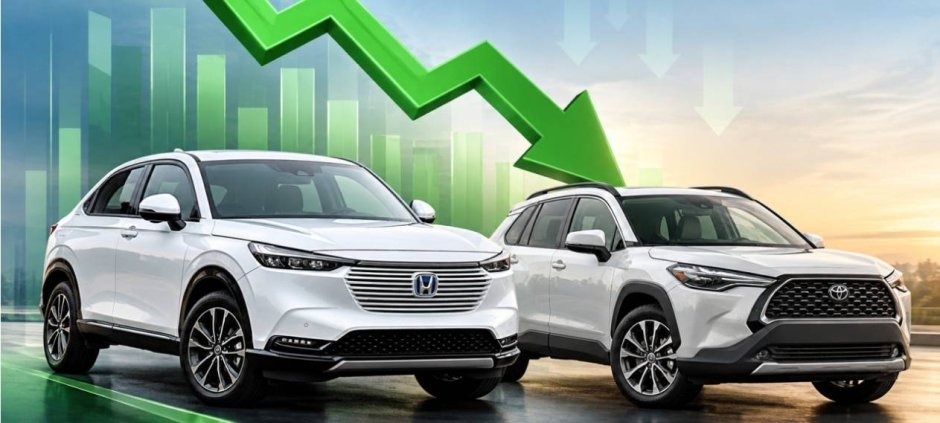
Hybrid electric vehicle (HEV) prices in Pakistan have started falling after the government reduced the General Sales Tax (GST) on vehicles up to 2,000cc from 25% to 18% on September 13.
Automakers did not immediately pass the tax reduction on to customers, but revised prices have now started to emerge. Honda Atlas Cars Ltd (HACL) and Indus Motor Company (IMC) have announced price reductions on several models, giving buyers lower prices on selected hybrid vehicles.
Honda Cuts HR-V Hybrid Price
Honda Atlas has reduced the price of its HR-V e from Rs10.369 million to Rs9.299 million.
The Rs1.07 million reduction brings the price of the hybrid SUV below the Rs10 million mark.
Honda has also reduced the price of the HR-V VTi-S from Rs7.799 million to Rs7.299 million, representing a reduction of Rs500,000.
The company said the revised prices apply for a limited period and to limited available stock.
The new retail prices are applicable to orders invoiced on or after September 25, 2026.
Toyota Reduces Corolla Cross Prices
Indus Motor Company has also revised prices for its Toyota hybrid vehicles.
According to a company circular, the Toyota Corolla Cross HEV X is now priced at Rs9.729 million, reflecting a reduction of Rs570,000.
The price of the Corolla Cross HEV has also been reduced to Rs9.299 million, down by Rs550,000 from its previous price.
The latest reductions bring prices of several popular hybrid models closer to levels expected after the GST adjustment.
GST Reduction Drives Price Changes
The price reductions follow the government’s decision to lower GST on vehicles up to 2,000cc.
The tax had previously stood at 25%, while the revised rate is 18% from September 13.
However, assemblers did not immediately adjust vehicle prices after the tax change. The latest announcements indicate that manufacturers have now begun reflecting at least part of the tax reduction in retail prices.
The exact impact varies between models because pricing also depends on factors including stock availability, invoicing dates and company pricing decisions.
Auto Industry Faces Policy Uncertainty
The automotive industry has been operating amid uncertainty following the expiry of the Automotive Industrial Development Policy (AIDP) 2021-26 on June 30.
Under the previous policy framework, the GST rate applicable to electric vehicles was 8.5%.
The industry had expected a new automotive policy to take effect from July 1, but the replacement policy has not yet been announced.
Assemblers have said the lack of clarity has affected business planning, production schedules and investment decisions across the automotive value chain.
Several manufacturers also reportedly delayed vehicle invoicing during July and August because of uncertainty surrounding the applicable tariff and tax regime.
Hybrid Car Sales Could Recover
Industry sources expect vehicle sales to gradually return toward normal levels as greater clarity emerges over taxes and the new automotive policy.
However, uncertainty remains over whether GST could be reduced further or remain at the current 18% rate.
Future policy decisions could therefore influence vehicle prices and purchasing decisions in the coming months.
The industry is also monitoring the implementation of the new auto policy and its potential impact on local assembly, imports, investment and new-energy vehicles.
BYD Reaches 10,000 Vehicles in Pakistan
Meanwhile, Mega Motor Company (MMC), the official Pakistani partner of BYD, has announced that BYD has reached 10,000 vehicles on Pakistani roads.
The company described the milestone as the fastest expansion by a new entrant New Energy Vehicle (NEV) brand in Pakistan’s automotive history.
The development comes as competition in Pakistan’s automotive market continues to expand, particularly in the hybrid and electric vehicle segments.
New entrants are increasingly competing with established manufacturers as consumer interest in fuel-efficient and electric vehicles grows.
Automotive Market Enters New Phase
The latest hybrid price reductions come at a time of significant change in Pakistan’s automotive sector.
Lower GST has provided manufacturers with an opportunity to revise prices, while consumers are now seeing more affordable prices for selected hybrid models.
At the same time, manufacturers continue to seek clarity over the country’s future automotive policy.
With Honda and Toyota already announcing reductions and new-energy vehicle brands expanding their presence, the coming months could bring further changes to Pakistan’s vehicle market.
For buyers, the revised prices mean that some hybrid models are now available at significantly lower prices than before the GST reduction.
Also read: Hyundai Palisade Hybrid Prices Increased in Pakistan