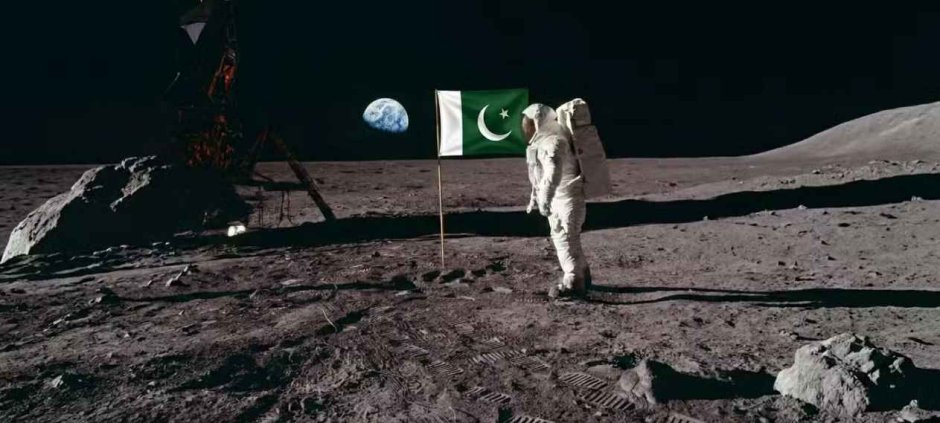
Pakistan is targeting a lunar landing by 2035 and plans to send a rover to the Moon. Planning Minister Ahsan Iqbal announced the ambition as part of the country’s expanding space program.
Speaking at a press conference in Beijing, Ahsan Iqbal highlighted Pakistan’s growing cooperation with China. He said the partnership was helping Pakistan advance its space exploration capabilities.
The minister also discussed Pakistan’s recent participation in a Chinese manned space mission. Pakistani astronaut Zeeshan Ali took part in the mission and visited the Chinese space station.
According to the minister, Pakistan became China’s first international partner in a manned space mission. Zeeshan Ali also became the first international visitor to the Chinese space station.
Ahsan Iqbal thanked Chinese President Xi Jinping, the Chinese government, and the China Manned Space Program. He acknowledged their role in providing Pakistan with the opportunity to participate.
The minister said Pakistan had launched approximately five satellites over the past two years. The country now plans to strengthen its space capabilities through further cooperation with China.
He also expressed optimism about Pakistan’s participation in an upcoming lunar mission. The mission is expected to involve deploying a rover on the Moon. It would contribute towards the country’s long-term lunar landing ambition.
Iqbal said Pakistan could benefit from China’s existing technological expertise and experience. This approach would help Pakistan avoid developing every space technology independently.
The minister also highlighted the practical benefits of space technology for Pakistan. He identified climate change, agriculture, water management, and disaster preparedness as important areas.
Satellite-based systems could improve flood monitoring and emergency response. They could also strengthen early-warning systems and support urban planning.
Referring to the climate-related disasters of 2022 and 2025, Iqbal emphasized technological preparedness. He said advanced systems could help Pakistan improve its resilience against future emergencies.
He also discussed the scientific experiments conducted by Zeeshan Ali during the mission. Their findings could support research in agriculture and materials science.
The research may help Pakistani scientists develop weather-resistant seeds and advanced industrial materials. These developments could support different sectors of the national economy.
The minister also acknowledged astronaut Khurram Dawood. He completed the training program alongside Zeeshan Ali but was not selected for the flight.
Separately, Iqbal announced plans to train at least 10,000 Pakistani PhD scholars. The proposed Pakistan-China Knowledge Corridor will support their education at leading Chinese universities.
The initiative will focus on artificial intelligence, space sciences, biotechnology, and materials science. Other priority areas include big data, automation, and robotics.
Ahsan Iqbal said the program would help develop skilled professionals and strengthen scientific research. He linked these initiatives with the government’s Uraan Pakistan program.
The program aims to increase Pakistan’s economy to $1 trillion by 2035. It also targets a $3 trillion economy by 2047.
The minister described the latest space collaboration as another phase in Pakistan-China relations. Cooperation between the two countries has also covered infrastructure, energy, and digital connectivity.
In other related news also read Actor Ahsan Khan’s father passes away
He said the partnership was now expanding into space exploration and advanced scientific research. These initiatives form part of Pakistan’s longer-term development and technology ambitions.