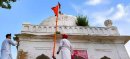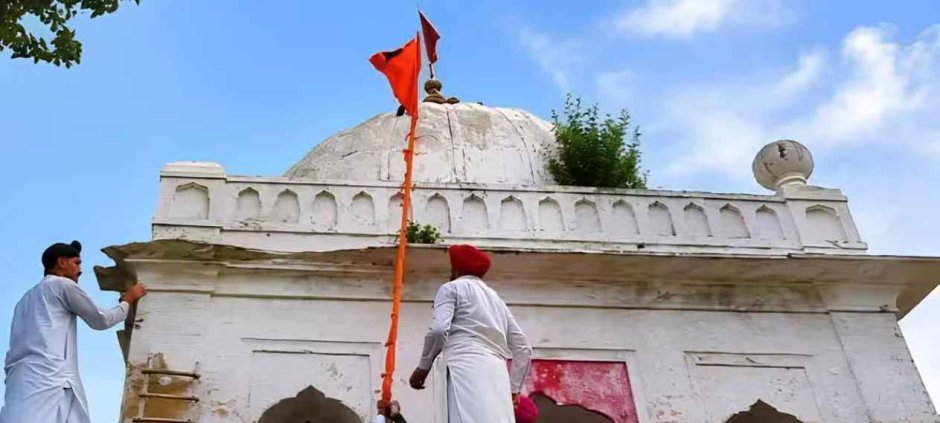
A historic Gurdwara in Lahore has reopened after remaining closed since the Partition of 1947. The religious site welcomed Sikh worshippers again on Sunday following decades of closure.
Gurdwara Chhevin Patshahi Sri Guru Hargobind Sahib is located on Temple Road in Mozang. The reopening ceremony was jointly organised by several government and Sikh community organisations.
The Evacuee Trust Property Board (ETPB), Pakistan Sikh Gurdwara Parbandhak Committee (PSGPC), and Punjab government arranged the event. A large number of Sikh community members attended the ceremony.
Punjab Minister for Minorities and PSGPC President Sardar Ramesh Singh Arora was also present. ETPB Secretary Nasir Mushtaq and other officials attended the occasion.
Gurdwara Holds Historical Links With Guru Hargobind Sahib
The historic Gurdwara is associated with Guru Hargobind Sahib, the sixth Sikh Guru. He lived between 1595 and 1644 and is remembered as a warrior-saint.
According to Sikh historical accounts, Guru Hargobind Sahib once visited the area. He accepted an invitation from the local Sikh congregation and stayed in Mozang for three days.
During his visit, he reportedly stayed at the home of Bhai Jiwan. The devotee later converted his residence into a Gurdwara to honour the Guru.
At that time, Mozang was situated on the outskirts of Lahore. The site gradually became an important place of religious and historical significance.
Shrine Also Linked to Bhai Bidhi Chand
The religious site also has connections with Bhai Bidhi Chand. He is remembered for recovering two horses named Dilbagh and Gulbagh.
According to Sikh accounts, the Mughal governor of Lahore had seized the horses. They were intended as a gift for Guru Hargobind Sahib.
Bhai Bidhi Chand reportedly travelled to Lahore twice to recover them. He eventually retrieved both horses from the royal stables inside Lahore Fort.
Historical accounts also suggest that he stayed at the Gurdwara during those visits.
Gurdwara Underwent Several Historical Changes
The local Sikh congregation expanded the Gurdwara hall in 1915. In 1921, the Sangat took control of its management.
This followed allegations of misconduct against Mahant Hari Singh. Community members later established a local management committee.
The old Gurdwara building was established in 1926 through Sardar Mehar Singh’s efforts. The Shiromani Gurdwara Parbandhak Committee assumed administrative control in 1927.
The original structure dates back to Maharaja Ranjit Singh’s period. Regular Sikh worship ended following the Partition in 1947.
More Than 50 Gurdwaras Undergoing Renovation
Speaking at the ceremony, Sardar Ramesh Singh Arora confirmed the restoration work’s completion. He said the shrine was now open for religious worship.
He also revealed that more than 50 Gurdwaras were undergoing renovation across Pakistan. These efforts aim to preserve Sikh heritage and improve facilities for pilgrims.
The reopening of the historic Gurdwara represents another step towards preserving religious heritage. It also provides Sikh worshippers access to an important historical site.
ETPB Highlights Religious Heritage Preservation
ETPB Secretary Nasir Mushtaq said the restoration would improve facilities for Sikh worshippers. He also highlighted the importance of protecting Lahore’s historical and religious heritage.
He said safeguarding Sikh and Hindu places of worship remained an important responsibility. He described the reopening as a positive development in these efforts.
Mushtaq appreciated Giani Balwant Singh and PSGPC committee member Professor Dr Mampal Singh. He recognised their contributions to the restoration project.
In other related news also read Lahore Takes Action Against Smoke-Emitting Vehicles
He added that the ETPB’s shrines department would continue restoration work. Its efforts will cover historic Gurdwaras and temples across Pakistan.