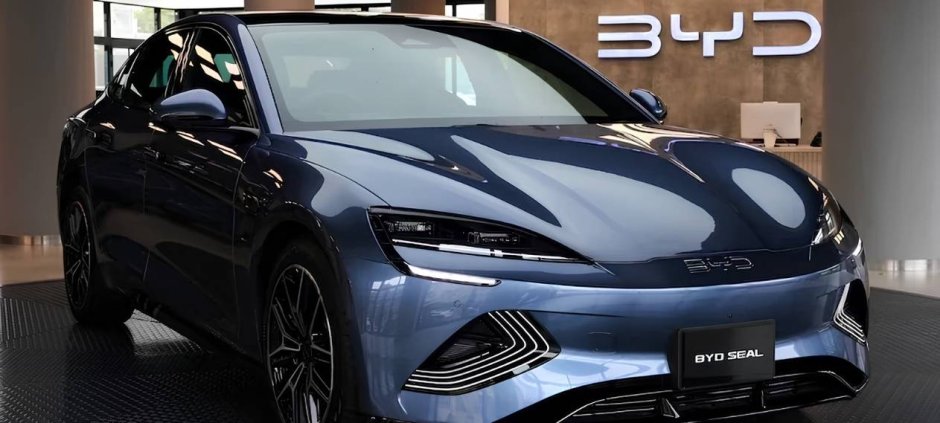
Chinese automobile manufacturer BYD is preparing to begin local vehicle production in Pakistan in December 2026, with the Sealion 6 plug-in hybrid electric vehicle (PHEV) expected to become the first model assembled locally.
The development was shared during a management briefing by Hub Power Company (HUBCO), which is expanding its presence in Pakistan’s electric vehicle market through its partnership with BYD and Mega Motor Company (MMC).
According to a report by Arif Habib Limited (AHL), which attended the briefing, management expects the company’s electric mobility business to gain further momentum after completely knocked down (CKD) production begins at its assembly plant near Karachi.
The update comes after cumulative BYD vehicle sales in Pakistan exceeded 10,000 units. The electric mobility business also reported a profit of approximately Rs1.5 billion during the first quarter of fiscal year 2026-27, with HUBCO’s share amounting to Rs780 million.
The planned production launch represents an important development for Pakistan’s automotive industry as the country gradually expands its electric and plug-in hybrid vehicle manufacturing capacity. <Cite refs={[“turn572759view0″,”turn740382search9”]}/>
BYD Local Production to Begin in December 2026
HUBCO management has confirmed that local production of BYD vehicles is targeted to begin in December 2026.
The company expects the initial production process to operate under a CKD assembly model, in which vehicles are assembled locally using imported components and parts.
The Sealion 6 PHEV is expected to become the first BYD model assembled at the facility.
The launch will mark a transition from the company’s existing completely built-up (CBU) import model towards local assembly in Pakistan.
Under the CBU model, vehicles arrive in the country as fully assembled units. CKD production, on the other hand, involves bringing vehicle components into Pakistan and assembling them at a local manufacturing facility.
The change is expected to support the expansion of BYD’s operations and create opportunities for the development of domestic automotive manufacturing capabilities.
However, the initial assembly process should not be confused with complete local manufacturing, as imported components will continue to play a major role during the early stages.
Sealion 6 PHEV to Become First Locally Assembled BYD
The BYD Sealion 6 plug-in hybrid electric vehicle is expected to lead the company’s local assembly programme.
A plug-in hybrid combines a conventional petrol engine with an electric motor and rechargeable battery. Unlike a fully electric vehicle, it can also use petrol when the electric charge is insufficient or additional driving range is required.
The Sealion 6 is part of BYD’s wider electrified vehicle lineup and is positioned in the crossover SUV category.
Its expected local assembly could give the company an opportunity to expand the availability of its plug-in hybrid technology in Pakistan.
The exact specifications, locally assembled version’s equipment package and pricing have not been confirmed in the reported management briefing.
Buyers should therefore wait for official announcements before assuming that the locally assembled version will have the same specifications or price as imported units.
BYD Pakistan Sales Cross 10,000 Units
BYD’s business in Pakistan has recorded significant sales growth since entering the passenger vehicle market.
According to AHL’s report, cumulative BYD vehicle sales in Pakistan have exceeded 10,000 units.
The company’s electric mobility business generated approximately Rs1.5 billion in profit during the first quarter of FY2027.
Of this amount, HUBCO’s share of the profit stood at approximately Rs780 million.
The figures indicate that the company’s automotive investment has started contributing to its wider business operations.
Management expects further growth following the beginning of local CKD assembly, as production in Pakistan could support the expansion of vehicle availability and the company’s overall operations.
HUBCO’s investment in the sector also gives it exposure to Pakistan’s developing electric mobility market alongside its established power generation business. <Cite refs={[“turn572759view0”]}/>
BYD Plant Near Karachi to Produce 25,000 Vehicles Annually
The manufacturing facility is being developed near Karachi in Gharo, District Thatta, through a partnership involving BYD and Mega Motor Company.
According to the Pakistan Credit Rating Agency (PACRA), the plant covers approximately 73 acres and is being developed with a targeted initial annual production capacity of 25,000 vehicles on a double-shift basis.
The facility is designed to scale up production to 50,000 vehicles annually if required.
The planned capacity is significant for Pakistan’s automotive industry, particularly as demand for electric and hybrid vehicles continues to develop.
A double-shift manufacturing operation allows a facility to operate for longer hours through multiple work shifts, increasing the number of vehicles it can assemble without requiring an entirely separate production facility.
The expansion to 50,000 units would depend on future investment, production requirements and market demand.
PACRA has identified the timely completion and commissioning of the plant as an important factor in Mega Motor Company’s operational development. <Cite refs={[“turn572759view2″,”turn740382search0”]}/>
Localisation to Increase Gradually to 80%
Although BYD’s initial production will rely heavily on imported parts and raw materials, HUBCO management has outlined a long-term plan to increase local content.
According to a corporate briefing reported by Dawn on October 21, the company initially expects to import the raw materials and components required for vehicle assembly.
However, its long-term objective is to achieve up to 80% localisation.
Increasing local content could help reduce dependence on imported components, improve production efficiency and strengthen the domestic automotive supply chain.
Greater localisation may also create opportunities for Pakistani manufacturers to supply parts, components and other materials required by the industry.
However, reaching the 80% target will require the development of local suppliers, technical capabilities, quality-control systems and manufacturing infrastructure.
The transition is expected to take place gradually rather than immediately after production begins. <Cite refs={[“turn572759view1″,”turn572759view2”]}/>
HUBCO Evaluating More BYD Models for Pakistan
Alongside the Sealion 6, HUBCO is also evaluating additional BYD vehicles for the Pakistani market.
According to AHL’s briefing report, the company is considering models particularly suited to higher-volume B and C vehicle segments.
The BYD Sealion 6, B8 and B5 were also mentioned in the discussion of the company’s expected vehicle lineup around the end of calendar year 2026.
These developments indicate that the company is considering a broader product range rather than relying on a single model.
Introducing additional vehicles across different market segments could help BYD reach more customers with varying preferences and budgets.
However, the evaluation of models does not necessarily mean that every vehicle will be locally assembled immediately. The final model lineup and production arrangements will depend on subsequent company announcements.
HUBCO Expands Its Investment in Electric Mobility
HUBCO’s involvement in Pakistan’s automotive sector is part of its broader effort to diversify its business operations.
BYD entered Pakistan’s passenger vehicle market in March 2024 through its partnership with Mega Conglomerate.
The partnership subsequently developed through Hub Power Holdings, HUBCO’s wholly owned subsidiary, and its associated company, Mega Motor Company.
MMC is responsible for manufacturing, marketing and distributing BYD-branded passenger vehicles in Pakistan.
HUBCO has also expressed interest in developing electric vehicle charging infrastructure, building on its experience in the power generation sector.
Charging facilities are an important part of electric vehicle adoption because drivers need convenient access to charging points when travelling between cities or using their vehicles for daily transportation.
The development of local vehicle assembly alongside charging infrastructure could support the gradual expansion of Pakistan’s electric mobility ecosystem.
What BYD’s Local Production Means for Pakistani Buyers
The start of local BYD assembly could bring changes to Pakistan’s automotive market by introducing a domestic production and assembly operation for the Chinese manufacturer.
Local assembly may eventually help improve vehicle availability and reduce some of the costs associated with importing completely built vehicles.
However, the immediate impact on retail prices is not yet known.
Since the initial production phase will rely heavily on imported components, the actual cost advantage will depend on import expenses, taxes, currency movements, manufacturing costs and the level of local content.
The planned capacity of 25,000 vehicles annually, with potential expansion to 50,000, also provides an indication of the company’s production ambitions.
For consumers, the most important developments to watch will be the official launch of the locally assembled Sealion 6, its confirmed specifications, pricing and the availability of additional models.
December Launch Marks a New Phase for BYD in Pakistan
HUBCO’s December 2026 production target marks another step in BYD’s expansion into Pakistan’s automotive industry.
With more than 10,000 cumulative vehicle sales already reported, the company is preparing to move beyond imports towards local CKD assembly.
The Sealion 6 PHEV is expected to lead the first production phase, while additional models remain under consideration.
The plant near Karachi will initially target 25,000 vehicles annually, with the ability to expand production to 50,000 units.
Although the initial phase will depend on imported components, the longer-term target of 80% localisation could create opportunities for domestic suppliers and strengthen Pakistan’s automotive manufacturing base.
The success of the project will depend on timely production, market demand, investment in local suppliers and the company’s ability to gradually increase domestic manufacturing.
Also; read: Is BYD a Game Changer? Electric Cars by BYD Enter the Pakistani Market