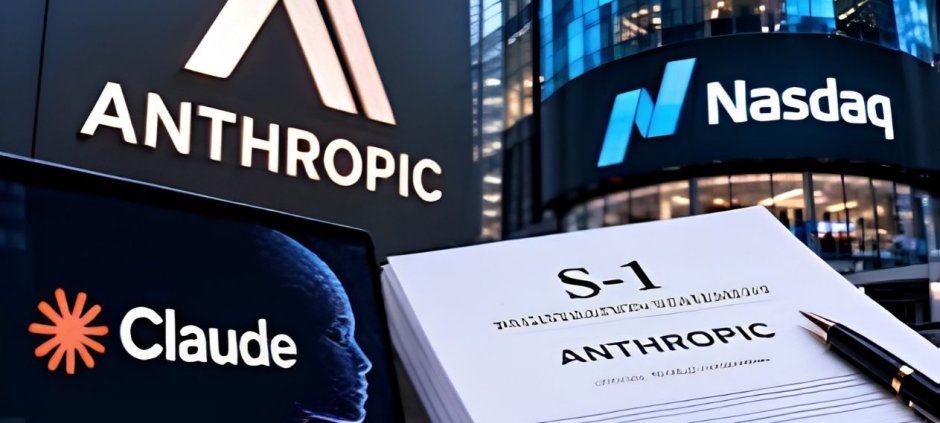
Artificial intelligence company Anthropic, the developer of the Claude AI assistant, has officially filed to go public in the United States, marking a major step towards a potential stock market debut. The company’s registration statement reveals rapid revenue growth, substantial financial risks and a governance structure designed to preserve the founders’ influence over its future direction.
Anthropic filed a Form S-1 registration statement with the US Securities and Exchange Commission (SEC) on Monday, October 26, 2026. The company plans to list its Class A common stock on the Nasdaq Global Select Market under the ticker symbol ANT.
The filing reports revenue of $16.3 billion for the first half of 2026, compared with approximately $1.2 billion during the same period last year. However, Anthropic also reported a net loss of approximately $80.7 billion, largely driven by noncash accounting adjustments linked to convertible debt.
The company’s operating loss was considerably smaller at $693 million, highlighting the difference between its operating performance and the accounting factors affecting its overall net result. Sources: SEC filing and TechCrunch.
Anthropic Revenue Jumps From $1.2 Billion to $16.3 Billion
Anthropic’s latest financial disclosure highlights the rapid expansion of its AI business during the first half of 2026.
The company generated approximately $16.286 billion in revenue during the six months ended June 30, 2026, compared with $1.163 billion in the corresponding period of 2025.
The increase reflects growing demand for AI services, particularly among corporate customers using Claude for software development, research, automation and other commercial applications.
Anthropic has become a major participant in the AI market as businesses increasingly integrate advanced language models into their operations.
Its revenue growth demonstrates the commercial opportunity associated with enterprise AI adoption. However, revenue growth alone does not establish whether a company can generate sustainable profits, particularly when operating sophisticated AI models requires significant computing resources and infrastructure investment.
The IPO filing allows prospective investors to examine the company’s financial performance, business risks and plans as it prepares for a possible public listing.
Why Did Anthropic Report an $80.7 Billion Net Loss?
One of the most striking figures in the registration statement is Anthropic’s reported net loss of approximately $80.7 billion for the first half of 2026.
The company’s operating loss during the same period was $693 million, compared with an operating loss of approximately $2.1 billion in the first half of 2025.
The difference is substantial because net income or loss includes items beyond the results of a company’s core operations.
According to the filing and reporting by technology publications, the exceptionally large net loss was driven largely by noncash accounting adjustments associated with convertible debt and related financing arrangements.
Such accounting adjustments can affect reported earnings without representing an equivalent cash payment during the reporting period. Consequently, the $80.7 billion figure should not be interpreted as $80.7 billion in cash spent on operating the business.
Nevertheless, Anthropic still reported an operating loss, meaning its operating expenses exceeded the revenue recognised during the period.
The company has also warned investors that it may not achieve or sustain profitability in the future.
For prospective shareholders, the distinction between operating losses, noncash accounting adjustments and actual cash requirements will be an important part of assessing the company’s financial position.
Enterprise Customers Drive Anthropic’s Expansion
The filing provides further details about Anthropic’s growing customer base, particularly among large organisations.
As of September 30, 2026, the company had more than 11,900 customers generating at least $100,000 in annual revenue each.
Around 1,900 customers generated at least $1 million annually, while approximately 250 customers generated $10 million or more.
These figures demonstrate the scale of Anthropic’s enterprise business and the extent to which its AI tools are being adopted by organisations with substantial spending capacity.
Businesses can use Claude for a variety of applications, including writing and reviewing software code, analysing documents, supporting research and automating parts of their workflows.
Large enterprise contracts can provide recurring revenue opportunities, although customer spending may fluctuate as companies review their technology budgets or adopt competing AI systems.
Anthropic has cautioned that its revenue growth rate could slow as its revenue base expands and the AI market matures.
For investors, the company’s ability to retain customers, expand commercial adoption and manage the cost of delivering AI services will remain important factors in evaluating future performance.
Anthropic Founders to Retain 50.1% Voting Power
Anthropic’s proposed corporate structure is another important feature of its IPO filing.
The company’s seven co-founders—Dario Amodei, Daniela Amodei, Tom Brown, Jack Clark, Jared Kaplan, Sam McCandlish and Christopher Olah—are expected to exercise collective voting control through an entity called Founder LLC.
According to the registration statement, Founder LLC will hold a special Class F share carrying 50.1% of shareholder voting power on matters submitted to shareholders generally.
The founders’ voting arrangement is intended to preserve their influence over major company decisions after the IPO.
Anthropic says this structure is designed to help protect its stated mission of developing AI safely and responsibly.
However, the arrangement also means that ordinary public shareholders will have limited influence over decisions covered by the founders’ voting control, regardless of the number of shares they purchase.
This distinction is important because ownership of publicly traded stock does not necessarily translate into proportional voting power when a company uses special share classes.
The final practical balance of influence will depend on the governance provisions described in the company’s registration statement.
Long-Term Benefit Trust to Help Oversee the Board
Anthropic’s governance structure also includes the Long-Term Benefit Trust, established in 2023 to help preserve the company’s public-benefit mission.
Under the proposed arrangement, the trust will have the authority to appoint and remove the majority of the company’s board through its special Class T share.
The structure separates certain governance powers from ordinary shareholder voting rights.
Anthropic says the arrangement is intended to ensure that the company’s long-term commitments to responsible AI development remain central to its decision-making.
For public-market investors, however, it introduces a different governance model from one in which shareholders exercise influence in direct proportion to their economic ownership.
The trust’s role could limit the ability of ordinary investors to influence the composition of the board, even after the company becomes publicly traded.
The arrangement illustrates Anthropic’s attempt to balance access to public-market capital with its stated objective of maintaining oversight of the risks associated with advanced AI systems.
IPO Price and Fundraising Target Remain Undisclosed
Although Anthropic has filed its registration statement, several important details about the proposed offering remain unavailable.
The company has not yet disclosed the number of shares it intends to offer or a proposed price range.
It has also not confirmed the total amount it expects to raise through the IPO.
The registration statement remains subject to SEC review and must become effective before the securities can be sold under the offering.
The filing therefore represents a significant step towards a public listing, but it does not confirm the final date, size or valuation of the offering.
Potential investors will need to examine the final prospectus and the terms of the offering before making investment decisions.
Further disclosures may provide additional information about Anthropic’s financial commitments, business risks, share structure and plans for using the proceeds.
Major AI Infrastructure Commitments Add to Financial Risks
Anthropic’s expansion also depends on access to substantial computing capacity needed to train and operate its AI models.
The company’s registration statement describes major commitments involving cloud infrastructure and computing resources, reflecting the capital-intensive nature of advanced AI development.
These arrangements can help secure the processing capacity needed to serve customers, but they also create significant long-term financial obligations.
As demand for AI services rises, Anthropic will need to balance infrastructure spending with revenue growth, operational efficiency and the cost of developing future models.
Competition is another major consideration. The company operates in a market where other AI developers are investing heavily in new models, computing infrastructure and enterprise services.
Its ability to maintain a competitive position will depend on product performance, customer adoption, pricing, technological progress and its management of costs.
Anthropic’s IPO filing also outlines risks related to AI safety, intellectual property disputes, regulation and the possibility of serious incidents involving AI systems.
These factors could influence both its future operating performance and investor assessments of the company.
What Anthropic’s IPO Filing Means for Investors
Anthropic’s move towards a public listing gives investors an opportunity to examine one of the major companies developing advanced AI technology.
Its first-half revenue of $16.3 billion demonstrates substantial commercial growth, while its operating loss of $693 million shows that the business has not yet achieved operating profitability.
The reported $80.7 billion net loss requires careful interpretation because it was largely driven by noncash accounting adjustments associated with convertible debt.
The proposed governance arrangement is another important consideration, as the founders and Long-Term Benefit Trust will retain substantial influence over shareholder voting and board appointments.
For now, Anthropic has not set its share price or disclosed how much it intends to raise. The offering remains subject to regulatory review, and the final terms may change before shares are sold.
The filing marks a major development in the AI industry, but investors will need to assess the company’s financial performance, infrastructure commitments, governance structure and risks before determining how they value its proposed public offering.
Also read: SpaceX Surges Past Amazon After Record-Breaking IPO