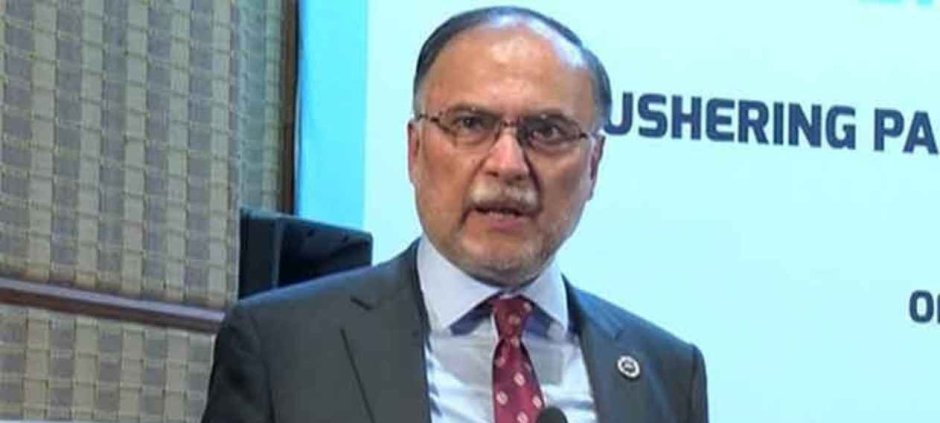
Federal Minister for Planning, Development and Special Initiatives Ahsan Iqbal has called for treating education, health, nutrition, clean water, and population growth as national emergencies.
He said Pakistan needs sustained efforts over the next 10 years to improve its social indicators. He made these remarks during the first meeting of the Human Capital and Skills Mission.
The meeting was held under the Uraan Pakistan framework on October 7. The mission is among 11 national economic missions approved under the framework.
Ahsan Iqbal stressed the need for stronger coordination between federal, provincial, and local governments. He also called for transferring greater powers to district governments.
According to him, basic services should reach citizens at their doorsteps. He said empowered local institutions could improve service delivery across key social sectors.
The minister also highlighted the importance of policy continuity and political stability. He questioned where Pakistan should stand when it completes 100 years of independence in 2047.
He said the country must maintain the same determination for development that it has shown in other national efforts. He also described human capital and skills as key foundations for future economic growth.
The meeting reviewed several challenges facing Pakistan’s human development. The country ranked 168th among 193 countries on the Human Development Index.
Pakistan’s Human Capital Index score was recorded at 0.41. This means a child born in Pakistan could reach 41 percent of potential productivity.
Child stunting affected 40.2 percent of children. This was reported as the highest rate in the region. Maternal mortality stood at 186 deaths per 100,000 live births.
The briefing also showed major challenges in education. Around 26 million children were reported to be out of school.
Only 46 children out of every 100 entering public schools reached grade 10. Literacy rates also varied significantly across provinces.
Punjab recorded a literacy rate of 68 percent. Balochistan recorded a rate of 49 percent.
Workforce participation was another major concern discussed during the meeting. Women’s labor force participation stood at 22.7 percent.
The corresponding rate for men was 68.7 percent. Around 45.4 percent of young women were outside education, employment, or training.
Only around 11 percent of people received technical and vocational training. Meanwhile, approximately two million young people enter Pakistan’s labor market annually.
The briefing noted that national immunization coverage had reached 81.3 percent. The government also discussed several targets under the Uraan Pakistan framework.
These include reducing maternal mortality by 35 percent. The plan also targets an 18 percent reduction in child stunting and under-five mortality.
The government aims to increase skilled birth attendance to 85 percent. It also plans to raise education spending to four percent of GDP.
Other targets include improving literacy by 10 percent and creating 1.5 million jobs annually. Women’s labor force participation is also targeted to increase by 17 percent.
Ahsan Iqbal said the 18th Amendment was intended to improve social services. However, he said limited devolution to local governments had slowed progress.
He argued that provincial-level administration alone cannot address local needs effectively. He called for stronger district institutions and administrative reforms.
The federal government would focus on national standards, coordination, data, and international commitments. Provinces would lead implementation in areas under their jurisdiction.
The proposed monitoring system will track population indicators and health targets. These include fertility rates, contraceptive use, and health spending.
The government plans to divide national targets into annual, provincial, and regional milestones. This will allow progress to be monitored more closely.
The meeting also discussed coordination through the National Population Council. Working groups will cover education, health, population, skills, and nutrition.
These groups will include relevant government departments and development partners. They are expected to meet every two weeks.
In other related news also read Ahsan Iqbal Clarifies Unexpected Live TV Moment
The meetings will focus on implementation barriers, progress reviews, and coordination of development spending. The minister said achieving the national missions would require sustained commitment and coordinated action.