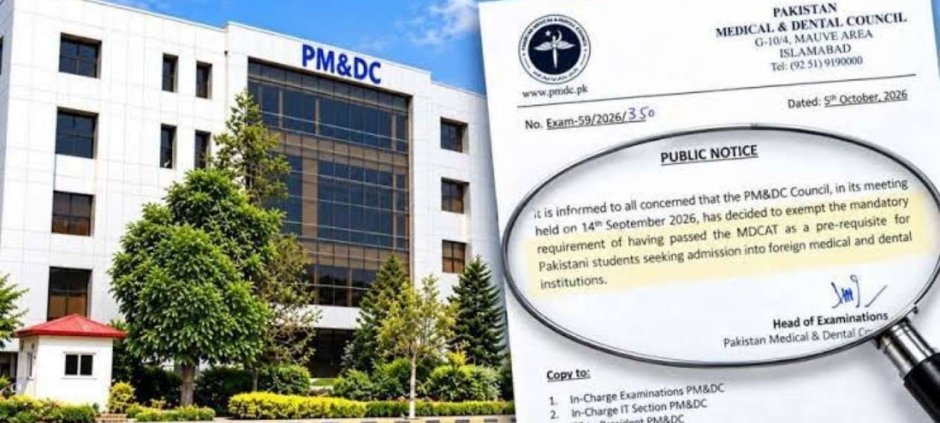
The Pakistan Medical and Dental Council (PMDC) has announced that Pakistani students seeking admission to medical or dental institutions abroad will no longer be required to pass the Medical and Dental College Admission Test (MDCAT).
The decision provides relief to students planning to pursue medical or dental education outside Pakistan. According to a PMDC notice, the council approved the exemption during a meeting held on September 14, 2026.
The council did not provide a detailed reason for the decision in its notice. However, PMDC President Dr Rizwan Taj told Dawn that the decision followed a recommendation from a parliamentary committee.
MDCAT Requirement Removed for Foreign Admissions
Under the new decision, Pakistani students seeking admission to foreign medical and dental institutions will not have to clear MDCAT as a mandatory requirement.
The issue had previously generated discussion among lawmakers and health authorities, particularly over whether Pakistan-based admission requirements should also apply to students who intend to study medicine or dentistry outside the country.
The exemption is expected to simplify the process for students who have already decided to pursue their medical education abroad.
However, the decision does not remove other requirements that may apply to students who later want to continue their education or practise medicine in Pakistan.
Parliamentary Committee Recommended Exemption
According to PMDC President Dr Rizwan Taj, a parliamentary committee had recommended that students travelling abroad for medical education should not be required to pass MDCAT.
The matter had also been discussed by the Senate Standing Committee on National Health Services, which raised concerns about the council’s previous policy requiring MDCAT for students seeking admission to foreign medical institutions.
The committee’s discussions focused on whether the MDCAT requirement was appropriate for students who were not seeking admission to Pakistani medical or dental colleges.
Lawmakers also raised broader concerns about the quality of foreign institutions where Pakistani students pursue medical education.
Concerns Over Foreign Medical Institutions
While recommending the MDCAT exemption, the parliamentary committee also called for stronger regulation of foreign medical institutions that may not meet the required standards.
It recommended that authorities identify and publish a list of foreign medical institutions that do not meet the necessary standards.
The issue is significant because a large number of Pakistani students seek medical education in countries outside Pakistan. Ensuring that students attend institutions meeting acceptable academic and professional standards remains important for those who eventually want to work in Pakistan.
The earlier MDCAT policy had reportedly been presented by PMDC officials as a measure aimed at discouraging students from enrolling in substandard foreign medical institutions.
However, members of the Senate committee questioned whether requiring MDCAT would effectively address that issue.
Senate Sub-Committee Questioned MDCAT Policy
Before the latest decision, a Senate sub-committee had also examined the legality of making MDCAT mandatory for students seeking admission to medical institutions abroad.
Committee members questioned whether the policy had sufficient statutory backing.
PMDC officials had explained that the requirement was intended to help discourage students from choosing foreign institutions that did not meet appropriate standards. However, lawmakers questioned the connection between passing Pakistan’s medical college entrance test and ensuring the quality of a foreign institution.
The subsequent decision has now removed the MDCAT requirement for students seeking initial admission abroad.
Transfer to Pakistan Still Requires Assessment
The MDCAT exemption does not mean that students studying abroad can automatically transfer to a Pakistani medical or dental institution without meeting other requirements.
According to a PMDC official, students who begin their medical education abroad and later seek to transfer to a university in Pakistan will still have to meet the applicable assessment requirements.
Students in such circumstances may be required to pass the National Examination Board (NEB) assessment conducted by PMDC.
The NEB examination is held twice a year for medical graduates who have studied abroad and seek transfer or admission-related pathways in Pakistan.
Therefore, students planning to return to Pakistan during their studies should carefully review the applicable PMDC rules before making academic decisions.
Foreign Medical Graduates Must Pass Registration Exam
The latest exemption also does not remove the examination requirements for foreign medical graduates who eventually want to practise in Pakistan.
Students who complete their medical education abroad and later seek to practise medicine in Pakistan will still be required to pass the relevant registration examination for foreign medical graduates.
The examination is part of the process for obtaining the necessary registration and licence to undertake a house job and practise medicine in Pakistan.
This means the new decision primarily concerns the admission stage for Pakistani students seeking medical or dental education abroad, rather than the requirements for practising medicine in Pakistan after graduation.
What the Decision Means for Students
The PMDC decision gives Pakistani students greater flexibility when applying to foreign medical and dental institutions.
Students who plan to study abroad can now pursue admission without first having to clear MDCAT solely because they intend to enrol in a foreign institution.
However, prospective students should still carefully investigate the recognition status, academic quality and professional standing of any foreign institution before enrolling.
They should also understand the requirements that will apply if they later want to transfer to Pakistan or practise in the country after completing their degree.
The latest policy therefore removes one admission requirement while maintaining separate assessment and registration requirements for students who eventually seek academic or professional opportunities in Pakistan.
Also read: Sindh MDCAT 2026 Final Result Announced