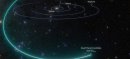
Scientists have identified a new icy object beyond Pluto that could become the next recognised dwarf planet in our solar system. The object, named 2026 ED138, was detected using the Vera C. Rubin Observatory in Chile. Researchers say it could be among the largest dwarf planets if further observations confirm its size and physical characteristics.
The discovery has attracted scientific interest because the distant region beyond Neptune contains many icy objects that remain difficult to study. The new finding suggests that astronomers may still have important discoveries to make about the outer solar system.
However, scientists have not yet confirmed that 2026 ED138 meets all the requirements to be classified as a dwarf planet.
What Do Scientists Know About 2026 ED138?
Researchers estimate that 2026 ED138 has a diameter of approximately 600 to 1,500 kilometres. It orbits the Sun at a distance around 46 times greater than the average distance between Earth and the Sun.
For comparison, Pluto orbits the Sun at an average distance of about 40 times Earth’s distance from our star.
The object lies in a cold region of the solar system beyond Neptune, where numerous icy bodies orbit the Sun. These distant objects receive much less sunlight than planets closer to Earth, making them challenging to observe.
Scientists still need to determine the object’s physical size more accurately. Its brightness alone cannot provide a definite measurement because a small, highly reflective object can appear as bright as a much larger object with a darker surface.
Vera C. Rubin Observatory Helps Detect the Object
The discovery was made using the Vera C. Rubin Observatory, located on Cerro Pachón in central Chile. The observatory is a joint initiative of the US National Science Foundation and the US Department of Energy.
Its powerful telescope is designed to survey the night sky and help scientists identify objects that move or change over time. Such observations can reveal distant bodies that might otherwise remain undiscovered.
Astrophysicist Matt Holman of the Center for Astrophysics, Harvard and Smithsonian, was the first to identify 2026 ED138.
Holman said the discovery demonstrates that many exciting findings could still emerge from the Rubin Observatory and other telescopes.
The discovery was announced at a scientific meeting in Spokane, Washington.
Why Has the Object Not Been Declared a Dwarf Planet?
Although 2026 ED138 appears to have enough mass for its gravity to pull it into a roughly round shape, scientists need more evidence before confirming its classification.
Under the International Astronomical Union’s definition, a dwarf planet must orbit the Sun, have sufficient gravity to become nearly round, and not have cleared its orbital neighbourhood of other objects. It must also not be a natural satellite of another body.
Further observations will help researchers establish the object’s size and determine whether it meets the required criteria.
Scientists plan to investigate its physical properties using observations at longer wavelengths. These measurements could help estimate its size more reliably than visible-light observations alone.
How ALMA Could Help Confirm Its Size
Researchers have identified the Atacama Large Millimeter/submillimeter Array, known as ALMA, as one observatory that could help determine the object’s size.
Visible-light observations detect sunlight reflected from an object’s surface. The amount of reflected light depends on both its size and how reflective its surface is.
ALMA can observe longer wavelengths and detect thermal radiation emitted by an object itself. This information can help scientists estimate its physical size and distinguish between a smaller, brighter object and a larger, darker one.
More accurate measurements would help researchers assess whether 2026 ED138 qualifies as a dwarf planet.
Which Dwarf Planets Are Already Recognised?
The International Astronomical Union currently recognises five dwarf planets in the solar system: Pluto, Eris, Haumea, Makemake and Ceres.
Pluto, Eris, Haumea and Makemake orbit beyond Neptune, while Ceres is located in the main asteroid belt between Mars and Jupiter.
If scientists confirm the classification of 2026 ED138, it could join this group. Based on current estimates, its size could place it among the larger known dwarf planets, although its actual dimensions remain uncertain.
Pluto’s Reclassification and the Search for New Worlds
Pluto was long considered the ninth planet of the solar system. In 2006, the International Astronomical Union reclassified it as a dwarf planet after introducing a formal definition of what qualifies as a planet.
The decision was based partly on the requirement that a planet must clear its orbital neighbourhood of other objects. Pluto does not meet that condition.
Like Pluto, 2026 ED138 appears to belong to the distant, frigid region of the solar system populated by icy bodies.
The discovery highlights how scientists continue to refine their understanding of the objects surrounding our Sun. Further observations will determine whether 2026 ED138 becomes an officially recognised dwarf planet and reveal more about its size and composition.
Also read: Scientists Reveal Astonishing Secrets of Newly Discovered Planet