The formation of modern Iraq offers a historical example of how borders, political institutions and resource arrangements can shape a state long after they are established.
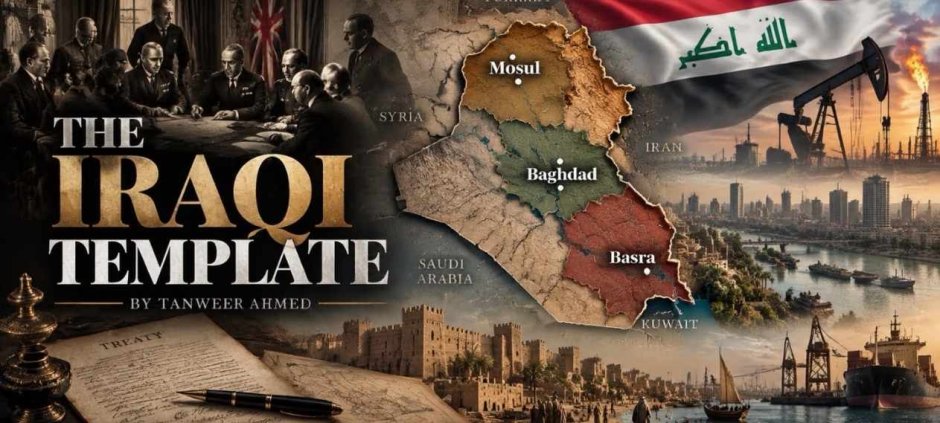
Before the creation of modern Iraq, the territory was largely organised under the Ottoman Empire through three separate provinces: Mosul, Baghdad and Basra. These provinces were administered separately for centuries and developed distinct economic and social characteristics.
The modern Iraqi state emerged during the period following the collapse of the Ottoman Empire, when Britain played a major role in determining the political and territorial structure of the region.
Three Ottoman Provinces Become One State
Mosul, Baghdad and Basra had different geographic and economic orientations.
Mosul was closely connected to Anatolia and the northern region, Baghdad developed around the Tigris and Euphrates river systems, while Basra’s location provided access to the Persian Gulf.
Although the three areas were connected through geography, trade and shared water systems, they had not previously functioned as a single sovereign political unit.
After the First World War and the collapse of Ottoman authority, British policymakers moved toward creating a unified political entity.
The arrangement reflected strategic considerations surrounding territory, security, trade and natural resources.
The Dispute Over Mosul
One of the most important territorial questions concerned Mosul, an area that later became particularly significant because of its oil resources.
Türkiye claimed Mosul after the First World War, while Britain sought to retain the territory within the emerging Iraqi state.
The dispute eventually reached the League of Nations, which determined in 1926 that Mosul would remain part of Iraq.
The oil potential of the region was an important element of the wider strategic environment surrounding the dispute.
The territory was subsequently incorporated into Iraq, giving the new state access to significant petroleum resources.
The 1920 Revolt
The creation of the new political order did not proceed without resistance.
In 1920, a major revolt broke out against British rule across areas that would become part of Iraq.
The uprising involved different communities and regions and posed a significant challenge to Britain’s administration.
British forces eventually suppressed the revolt, but the cost of maintaining direct control encouraged London to seek a different political arrangement.
The experience demonstrated the difficulties associated with governing the territory through direct occupation.
Faisal Becomes King
Britain subsequently supported Faisal bin Hussein as Iraq’s monarch.
Faisal had previously been involved in the Arab Revolt against the Ottoman Empire and had briefly ruled Syria before being removed following French intervention.
He was eventually installed as King Faisal I of Iraq in 1921.
His appointment became a central part of Britain’s effort to establish a local government while retaining substantial influence over Iraq’s political and security affairs.
A referendum held under the British mandate produced overwhelming support for Faisal, although historians have debated the circumstances and representativeness of the process.
Oil Concessions Shape the New State
Oil remained a major factor in Iraq’s early political and economic development.
The Turkish Petroleum Company, later renamed the Iraq Petroleum Company, secured important concession rights during the mandate period.
In 1925, the Iraqi government approved a major petroleum concession covering a large portion of the country’s territory.
The company was controlled by a consortium involving major international oil interests, including British companies.
The arrangement provided Iraq with royalties while allowing foreign companies substantial control over exploration and production under the concession system.
These agreements later became a major part of debates over Iraq’s sovereignty and control of its natural resources.
Independence Came in 1932
Iraq formally became an independent state in 1932, when it joined the League of Nations.
By that point, the country’s territorial framework and political institutions had already been established.
The monarchy remained in place, while British influence continued through military, diplomatic and economic relationships.
This sequence — territorial consolidation, establishment of a monarchy, resource concessions and eventual formal independence — shaped the country’s early political structure.
Nationalisation and the End of the Concession Era
Iraq’s relationship with foreign oil companies changed significantly in the decades that followed.
Political instability, military coups and changing attitudes toward natural resources gradually transformed the country’s economic system.
Iraq eventually nationalised its oil industry, with the process culminating in the nationalisation of the Iraq Petroleum Company in 1972.
The change transferred control of major petroleum resources to the Iraqi state.
However, nationalisation did not resolve the country’s wider political challenges.
A Legacy of Political Instability
The Iraqi monarchy ended in 1958, when a military coup overthrew the Hashemite monarchy and established a republic.
Iraq subsequently experienced repeated political upheaval, including further coups, authoritarian rule, wars and periods of sectarian conflict.
The later history of Iraq cannot be attributed to a single event or decision. Numerous domestic, regional and international factors influenced the country’s trajectory.
However, debates about the origins of the Iraqi state continue to focus on the circumstances under which its borders and institutions were created.
The Iraqi Template
The history of Iraq continues to be discussed in wider debates about state formation and the drawing of borders.
The Iraqi experience raises questions about what happens when territorial boundaries are established primarily through negotiations among external powers, while the populations living within those boundaries have limited influence over the process.
It also illustrates the long-term importance of early decisions involving political institutions and natural-resource concessions.
The central historical question is therefore not simply where borders were drawn, but how the political arrangements behind those borders were established and whose interests they initially served.
Iraq’s experience demonstrates that formal independence does not necessarily erase the political and economic structures inherited from an earlier period.
The country’s modern history was shaped by the interaction of borders, foreign influence, resource wealth, monarchy, military intervention and domestic political movements.
The Iraqi case remains relevant to discussions about state formation because the institutions and territorial arrangements created during the mandate period continued to influence Iraq long after the British mandate ended.
Also read: Pakistan and Kuwait Sign New Defense Cooperation Pact