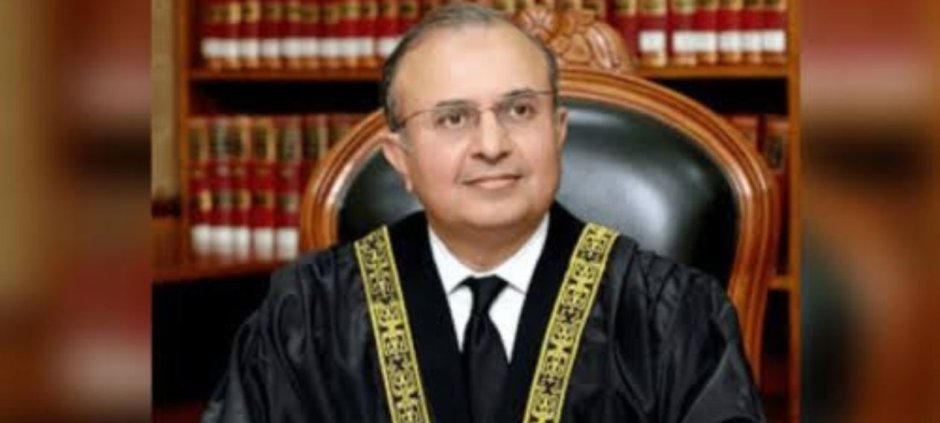
The Election Commission of Pakistan (ECP) has rejected former Supreme Court judge Justice (retd) Syed Mansoor Ali Shah’s interpretation of several major electoral cases, defending its decisions concerning provincial elections, the withdrawal of Pakistan Tehreek-e-Insaf’s (PTI) election symbol and the allocation of reserved seats.
In a statement issued on November 4, 2026, the ECP spokesperson criticised remarks made by Justice Mansoor Ali Shah during an interview with a foreign television channel, saying his interpretation contradicted constitutional provisions, applicable election laws and final Supreme Court judgments.
The commission maintained that judicial decisions should be discussed in their complete legal context rather than through selective references or incomplete accounts of court proceedings.
The ECP also explained the legal grounds behind its decisions involving the 2023 Punjab and Khyber Pakhtunkhwa (KP) election dispute, PTI’s intra-party elections and the subsequent allocation of reserved seats in Parliament and provincial assemblies.
The response has brought several important electoral controversies back into focus, particularly questions concerning the interpretation of Supreme Court verdicts and the constitutional responsibilities of the country’s election regulator.
ECP Defends Its Decisions on Punjab and KP Elections
One of the central issues addressed by the ECP was the Supreme Court proceedings concerning elections in Punjab and Khyber Pakhtunkhwa in 2023.
The dispute arose after the provincial assemblies were dissolved in January 2023, creating questions about the constitutional responsibility for announcing election dates.
The ECP spokesperson said the Supreme Court’s proceedings resulted in a 4-3 decision and rejected interpretations suggesting that the relevant suo motu proceedings and connected petitions had simply been dismissed.
The commission maintained that it was constitutionally required to act in accordance with the court’s directions and that its decisions were taken within the applicable legal framework.
However, the legal history of the case involved a complicated bench composition and differing judicial interpretations.
On March 1, 2023, a reconstituted five-member Supreme Court bench announced a 3-2 majority order directing elections in Punjab and KP. Justices Syed Mansoor Ali Shah and Jamal Khan Mandokhail dissented.
The two dissenting judges argued that earlier orders by Justices Yahya Afridi and Athar Minallah, who had initially favoured dismissing the proceedings, should also be counted, making the effective outcome 4-3.
The court’s subsequent majority reasoning rejected that interpretation and maintained the 3-2 outcome of the reconstituted bench. <Cite refs={[“turn280708search1″,”turn393877search3″,”turn280708search2″,”turn280708search3”]}/>
The disagreement over how the earlier proceedings should be counted has remained an important part of the legal debate surrounding the Punjab and KP election case.
Why PTI Lost Its Traditional Electoral Symbol
The ECP also defended its decision to withdraw PTI’s traditional electoral symbol, the cricket bat, ahead of the February 2024 general elections.
According to the commission, the party failed to conduct its intra-party elections in accordance with the Elections Act, 2017, despite receiving repeated notices and opportunities to fulfil the requirements.
The ECP referred to Sections 208 and 209 of the Elections Act, which establish requirements for political parties to conduct periodic intra-party elections and submit the relevant certification to the commission.
It also cited Section 215(5), which allows the ECP to declare a party ineligible to obtain an election symbol if it fails to meet the relevant legal requirements after being given an opportunity to respond.
The commission maintained that PTI was given three opportunities to comply before its symbol was withdrawn.
The matter eventually reached the Supreme Court, which upheld the ECP’s decision on January 13, 2024. The court concluded that PTI had failed to demonstrate that valid intra-party elections had been conducted in accordance with its constitution and the applicable law. <Cite refs={[“turn681967view2″,”turn725959view0″,”turn371328view1”]}/>
The decision meant PTI candidates had to contest the February 8, 2024 general elections using individual symbols rather than the party’s traditional cricket bat.
PTI Remains Registered as a Political Party
The ECP spokesperson clarified that the withdrawal of PTI’s electoral symbol did not mean that the party had been removed from the commission’s official record.
The commission said PTI remains registered as a political party.
This distinction is important because the legal status of a political party and its eligibility to obtain an election symbol are separate matters under the Elections Act.
Section 215 deals with eligibility to receive an election symbol, while the registration of political parties is governed by separate provisions.
The January 2024 Supreme Court judgment upheld the withdrawal of PTI’s symbol following the intra-party election dispute. It did not amount to an order dissolving or deregistering the party. <Cite refs={[“turn681967view2″,”turn725959view1”]}/>
The ECP reiterated this position while responding to the former judge’s interpretation of the electoral cases.
ECP Explains Allocation of Reserved Seats
The commission also defended its decisions concerning seats reserved for women and non-Muslims in the National Assembly and provincial assemblies.
According to the ECP spokesperson, political parties were required to submit priority lists of candidates for reserved seats under the applicable election rules.
The commission maintained that PTI did not submit the required priority list and that the reserved seats were consequently distributed among eligible political parties in accordance with the legal framework.
The issue became particularly controversial after PTI-backed independent candidates joined the Sunni Ittehad Council (SIC) following the February 2024 general elections.
PTI argued that its candidates’ affiliation with the party should be recognised when calculating the allocation of reserved seats.
In July 2024, an eight-member majority of a 13-member Supreme Court bench ruled in favour of PTI’s entitlement to a share of reserved seats.
However, that judgment was subsequently challenged through review petitions filed by the ECP and other political parties.
Supreme Court Reverses Earlier Reserved Seats Judgment
On June 27, 2025, the Supreme Court’s Constitutional Bench accepted the review petitions by a majority of seven judges, setting aside its July 2024 majority judgment.
The court restored the Peshawar High Court’s earlier decision, which had upheld the ECP’s position concerning the allocation of reserved seats.
The short order also dismissed the relevant appeals filed by the Sunni Ittehad Council.
There were separate opinions within the bench concerning the treatment of certain returned candidates, but the operative majority order reversed the earlier July 2024 ruling. <Cite refs={[“turn875283view1″,”turn774363search0″,”turn774363search1”]}/>
This later judgment is an important part of the legal background to the ECP’s latest statement.
The commission referred to the applicable court decisions while defending its position that reserved seats had been distributed according to the legal requirements and available party lists.
ECP Says Its Decisions Followed Constitutional and Legal Requirements
In its November 4 statement, the commission rejected the suggestion that its electoral decisions were inconsistent with the Constitution or Supreme Court judgments.
The spokesperson maintained that the ECP had acted within its legal authority while dealing with the Punjab and KP election dispute, PTI’s intra-party elections and reserved-seat allocations.
The commission also objected to what it described as selective references to judicial proceedings, arguing that court records should be considered in their complete context.
Its response focused on three major areas: the interpretation of the 2023 provincial election proceedings, the legal requirements for intra-party elections and the rules governing reserved-seat allocation.
The commission said its decisions were based on applicable constitutional provisions, the Elections Act and relevant Supreme Court rulings.
Election Commission’s Response Brings Electoral Disputes Back Into Focus
The ECP’s statement has renewed attention on some of Pakistan’s most significant electoral controversies from 2023 and 2024.
The disagreements involve the constitutional timeline for provincial elections, the requirements governing political parties’ internal elections, the withdrawal of PTI’s electoral symbol and the allocation of reserved seats.
These matters have involved multiple rounds of proceedings before the Supreme Court and other judicial forums, with different judgments and interpretations shaping the legal developments over time.
The commission’s latest response represents its defence of the decisions it took during those proceedings and its disagreement with Justice (retd) Mansoor Ali Shah’s interpretation.
The broader debate highlights the importance of transparent electoral administration, accurate interpretation of court judgments and public understanding of the legal framework governing elections in Pakistan.
For now, the ECP has reiterated that it considers its decisions legally justified and consistent with the final judicial rulings governing the respective cases.
Also read: ECP Suspends Membership of 159 Lawmakers Over Financial Statements